
Solar Contractor Insurance by State
Iowa Solar Contractor Insurance
Iowa licenses the business of new electrical installations through a contractor license that rests on a master electrician and a state registration, holds solar wiring to an adopted electrical code, has not confirmed a state rulebook for solar sellers, and makes workers’ compensation compulsory with no state fund.
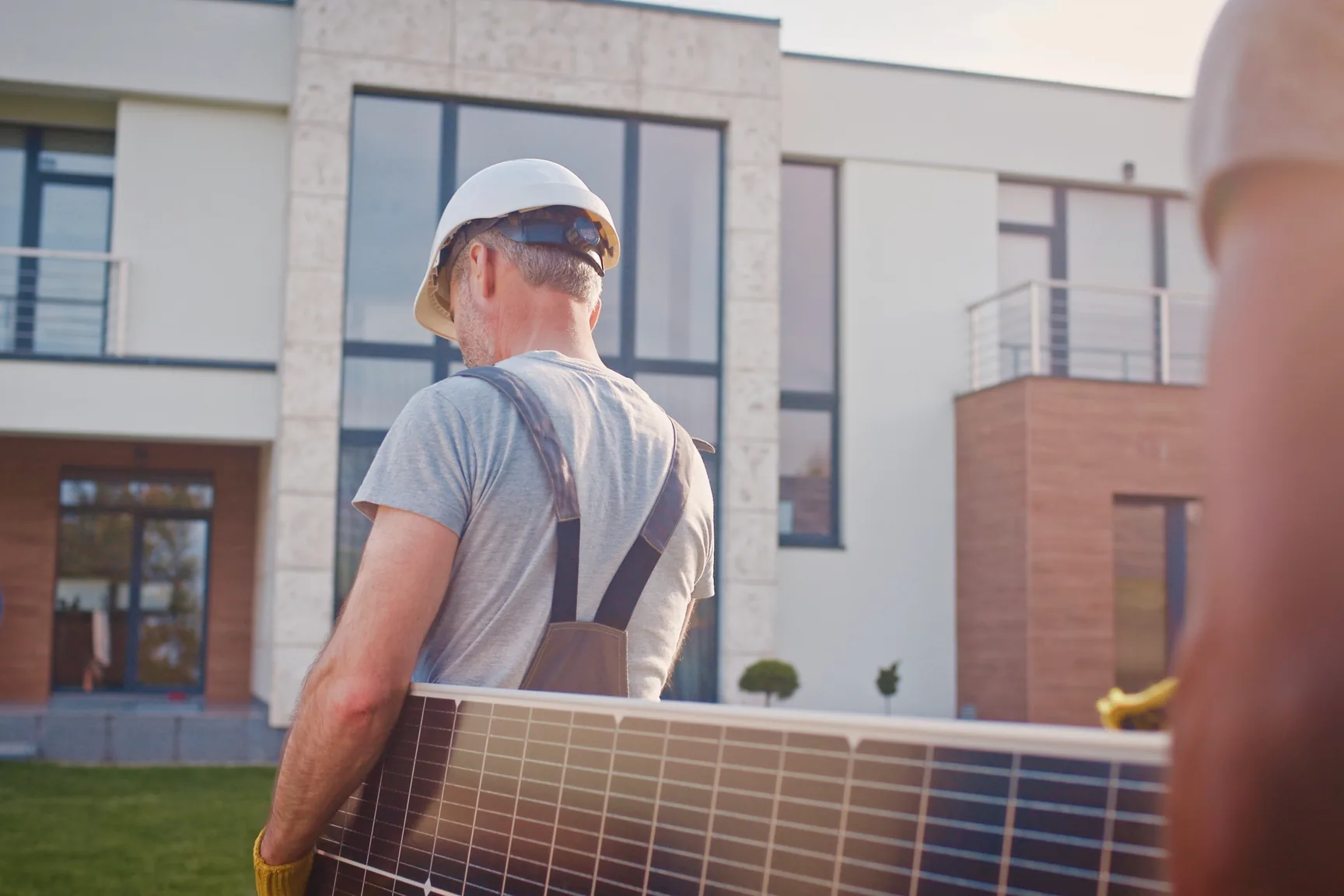
Iowa has no separate solar license class, but it does license the business of new electrical installations, and a solar installer’s wiring is electrical work. A solar contractor that wires systems holds an electrical contractor license, which rests on a master electrician and on the state’s construction contractor registration with the Department of Inspections, Appeals, and Licensing. That wiring is built to the electrical code the Department’s rule adopts, and a newer edition is proposed and not adopted. An Iowa consumer law aimed at solar sellers or installers is not confirmed at the state level, and workers’ compensation is compulsory for the employers the law covers, with no state fund behind it.
A caution runs through the sections that follow. The utility commission’s distributed generation safety section limits what that commission may require, and it does not repeal the licensing bar, so this page claims no exemption for a solar-only crew and does not claim that such a crew is covered. Where the record is silent, the page says so and leaves the question to the office that can answer it.
How the policies themselves work for a solar business anywhere is laid out on the solar contractor insurance page and the coverage pages it links to. This page keeps to what is particular to Iowa, whether your business does rooftop installation, runs panel cleaning and maintenance routes or takes on ground-mount and solar farm construction.
A waterfall in which each step takes what the step above leaves for it. At the top, only a licensed electrical contractor may engage in the business of new electrical installations, and the state has no separate solar class. Below it, that license rests on a master electrician, held or employed, and on the state’s construction contractor registration. Next, a city or county that runs its own electrical inspections can recognize the state license and set the permit fees. After that, the wiring is built to the adopted National Electrical Code, with a newer edition proposed and not adopted. Then the interconnection duties of the utility commission’s safety rules fall on the customer and the utility, and a state rulebook for solar sellers or installers is not confirmed. At the bottom, the crew is covered by compulsory workers’ compensation, met through an approved insurer, an approved employer group or proof of solvency, with no state fund. No figures are shown.
A contractor license that rests on a master electrician and a state registration
Iowa licenses electrical work statewide, and the licensing text read names no solar work; a solar installer’s wiring is covered only as electrical work. Only a person licensed as an electrical contractor may engage in the business of providing new electrical installations, and the contractor license rests on a master electrician license and on the state’s contractor registration. The state has no separate solar license class.
A solar contractor that wires systems in Iowa holds an electrical contractor license, with a licensed master electrician held or employed, and the crew works under journeyman or apprentice licenses; the contractor is also registered with the state as a construction contractor. A city or county that runs its own electrical inspections can recognize the state license and set the permit fees for work inside it.
Authority: Iowa Code 103.8; 103.9; 103.13; 103.22; 103.29; 91C.2
The licensing chapter writes the prohibition around the business, not only around the individual doing the work:
“No person, except a person licensed as an electrical contractor, shall engage in the business of providing new electrical installations or any other electrical services regulated under this chapter.”
What it takes to hold the contractor license is set in the chapter’s next section, and the license rests on a person and on a filing:
“An applicant for an electrical contractor license shall either be or employ a licensed class A or class B master electrician, and be registered with the state of Iowa as a contractor pursuant to chapter 91C.”
The filing is the registration the Department of Inspections, Appeals, and Licensing, Contractor Registration keeps, and the contractor registration chapter opens its duty in a short clause:
“A contractor doing business in this state shall register with the director”
As advice, decide before the bid who is the master electrician behind the contractor license, and keep the license and the registration in the same folder. Where the wiring is subcontracted, file the electrical contractor’s license beside its certificate of insurance. How a liability policy treats the electricians you bring in is set out on the general liability page.
Cities and counties that inspect, and a special license with no solar class
The licensing chapter speaks to local governments in its list of exceptions and again in its section on political subdivisions. The list of exceptions carves out work done under a local license, and the span below is the part of that carve-out the record keeps:
“Require any person doing work for which a license would otherwise be required under this chapter to hold a license issued under this chapter if the person is the holder of a valid license issued by any political subdivision”
The section on political subdivisions pulls the other way, protecting a holder of the state license from a repeat local fees and testing:
“A political subdivision shall not require any person holding a license from the board to pay any license fee or take any examination if the person holds a current license issued by the board”
Each of those sentences continues past the span quoted, with conditions on the local license and on the classification, so treat them as a pointer to the statute and not as the whole rule. As advice, ask the building office where the array goes up whether it inspects for itself, what license it wants on file and what its permit fees are, and write the answers into the job file.
The chapter also provides a limited license, the nearest the statute comes to a specialty class:
“The board shall by rule provide for the issuance of special electrician licenses authorizing the licensee to engage in a limited class or classes of electrical work”
The finding above is that the state has no separate solar class, so do not assume a limited license reaches photovoltaic wiring. As advice, put the question to the Electrical Examining Board in writing before a crew member holding a limited license is sent to a tie-in.
A utility safety section that limits itself and leaves the licensing bar standing
The Iowa Utilities Commission writes safety rules for interconnecting distributed generation, and its section ends with a limit on the commission itself. The section is not to be construed to authorize the commission to require that an installation, a disconnection device or an interconnection:
“be performed by a licensed electrician, installer, or professional engineer”
That sentence limits what the commission may require under its own section. It is not a repeal of the licensing bar quoted earlier, which sits in a different chapter and speaks to who may engage in the business of new electrical installations. This page therefore does not read the sentence as exempting a solar-only crew from the electrical contractor license, and it does not read the sentence as covering such a crew either.
As advice, get the answer in writing. Ask the Department of Inspections, Appeals, and Licensing how it reads your scope of work, from the racking to the point of connection, and keep the reply with its date and the name of the person who gave it.
Interconnection duties that fall on the customer and the utility, and no installer rulebook confirmed
An Iowa consumer law aimed at solar sellers or installers is not confirmed at the state level. The solar and distributed generation provisions found, the Utilities Commission’s distributed generation safety section and its interconnection rules, run to the customer that interconnects a system and to the electric utility, and set no registration, qualification or disclosure duty on the firm that sells or installs the system.
A solar contractor’s state obligations confirmed here come through electrical licensing and contractor registration. The customer that interconnects a system, not the contractor, carries the disconnection-device, placard and fire-department notice duties in the Utilities Commission’s safety rule.
Authority: Iowa Code 476.58; 476.49; Iowa Administrative Code 199—Chapter 45
The statute directs the commission to write the safety rules:
“the commission shall adopt rules pursuant to chapter 17A relating to the safe installation and operation of interconnections between distributed generation facilities and electric distribution systems.”
The Code defines the customer who carries such duties in terms that name the interconnection, not the sale:
“means a person other than a public utility that interconnects an eligible distributed generation facility to an electric distribution system.”
Those provisions are a finding about where the duties fall. They are not a statement that Iowa has a rule for solar sellers or installers somewhere else, and they are not a statement that it has none. A rule written for that audience is not confirmed at the state level, and this page does not fill the gap.
A contractor that prepares an interconnection application for a customer is still doing work the customer relies on. As advice, say in each proposal how the output estimate was produced, list every cost the customer will bear, and name who files the interconnection paperwork and who places the disconnection device. Keep a signed copy of what the customer received.
If a customer relies on an estimate that turns out wrong and nothing is damaged, the claim that follows is a professional liability question, and that page sets out how such a policy responds.
The adopted code edition, the Department’s notice and a newer edition still in rulemaking
Iowa applies the 2023 edition of the National Electrical Code statewide through the Electrical Examining Board’s rules and the statute that defines the code, and the state’s inspection program tells solar installers that the entire photovoltaic installation must comply with the code’s solar photovoltaic article. The state’s amendments leave that article as the edition prints it. A newer edition is proposed and not yet in effect.
Solar wiring in Iowa is built to the adopted edition of the electrical code and inspected by the state or by a city or county that runs its own inspections; the state inspection program asks the installer for a photovoltaic worksheet before the inspection. A newer edition is in rulemaking and does not apply yet.
Authority: Iowa Code 103.6; 103.1 (subsection 12A), 103.1B and 103.1C as added by 2026 Iowa Acts, House File 2800; Iowa Administrative Code 481—404.3
The Department’s rule takes the national code in by reference, and the sentence that does it names the edition:
“The provisions of the National Electrical Code, 2023 edition, published by the National Fire Protection Association, are incorporated herein by reference”
The Department’s electrical permits page speaks to the state of the code in plain words, in a notice about the Act cited above:
“Iowa has reverted entirely to the unamended 2023 National Electrical Code (NEC) published by the NFPA”
The same notice says how long the adopted standards last:
“These standards will remain the mandatory minimum enforcement threshold until the 2026 NEC is officially adopted.”
The newer edition is proposed and not adopted. A proposal is not an effective date, so until the board adopts it, the edition quoted above is the code a solar job is held to. The state’s inspection program also tells installers what it expects to see, in a worksheet it publishes for the inspector:
“The entire PV system installation must comply with Article 690, 691, & 705 of the 2023 National Electrical Code (NEC).”
The state’s amendments leave the solar photovoltaic article as the adopted edition prints it, so the worksheet’s articles are the ones to design to. The worksheet is the Department’s own instruction, which makes it the page to print and attach to the permit packet.
The authority a city or county holds to inspect decides who inspects, and the exemptions in the licensing chapter decide who must be licensed or inspected. Neither is a statement about which installations the adopted code reaches, and this page does not read them that way. As advice, make sure each crew lead knows which edition the inspector is reading from, and when a design leans on a provision found only in the newer edition, settle it with the inspector before the work.
A fault in wiring that comes to light after the job is finished is a general liability matter, and a clear record of the code you built to helps whoever has to answer it.
Comp from an approved insurer, an employer group or proven solvency, with no state fund
Workers’ compensation is compulsory in Iowa for employers its law covers. A covered employer insures with a company, association or organization approved by the Commissioner of Insurance, or is relieved of the insurance requirement by proving to the Commissioner that it can pay compensation itself. No state fund insures private employers; coverage comes from the private market.
A solar contractor with employees carries a workers’ compensation policy from an approved insurer or holds the Insurance Commissioner’s relief from insurance, and must have the coverage before engaging in business; the state also asks for the evidence when the contractor registers.
Authority: Iowa Code 85.3(1); 87.1(1); 87.11(1); 87.14A; 91C.2
Start with the duty. The workers’ compensation chapter says who must provide coverage:
“Every employer, not specifically excepted by the provisions of this chapter, shall provide, secure, and pay compensation according to the provisions of this chapter”
The insurance chapter then sets the usual route. An employer under the chapters:
“shall insure the employer’s liability under chapter 10A, subchapter III, this chapter, and chapters 85, 85A, and 85B, in some corporation, association, or organization approved by the commissioner of insurance.”
Notice what is absent from the insurance route: a state fund. The finding above is that no state fund insures private employers, so the approved insurer is chosen in the private market. The statute offers other routes. An employer may be relieved of the insurance requirement when it
“furnishes satisfactory proofs to the insurance commissioner of such employer’s solvency and financial ability to pay the compensation and benefits as by law provided”
and employers may also band together, because the statute lets
“groups of employers by themselves or in an association with any or all of their workers, may form insurance associations as hereafter provided”
A fund in the workers’ compensation chapter pays particular benefits; it insures no employer and issues no policy, so it is not a place to buy coverage. The registration the contractor license rests on also asks for evidence of coverage, as the obligation sentence above says.
How roof crews, ground crews and service technicians are classified, how subcontractors are treated at audit and how a policy follows a crew that travels are policy questions rather than Iowa questions, set out on the workers’ compensation page. As advice, settle before the season who on each job is your employee, and collect a certificate from every subcontractor before its people set foot on an array. Nothing on this page reaches past Iowa’s border; for a job in a neighboring state, check that state’s rules.
Iowa’s Workers’ Compensation Division sits inside the Department of Inspections, Appeals, and Licensing, as the list below shows. A crew’s ladder and roof work has its own federal reference in OSHA’s Fall Prevention Campaign.
The department, board and commission behind each finding
The Iowa Insurance Division is the state’s insurance regulator; the Commissioner of Insurance approves the insurers, associations and organizations that secure workers’ compensation liability and relieves qualifying employers of the insurance requirement. Any agency that sells you a policy, this agency among them, can be looked up on NIPR.com.
The Department of Inspections, Appeals, and Licensing houses the Electrical Examining Board, the electrical inspection program, contractor registration and the Workers’ Compensation Division. Some of the bodies listed next sit inside it, which is why its name returns on this page. Each link goes to the body’s own site, and each role is given as the source states it:
- Electrical Examining Board: licenses electricians and electrical contractors and adopts the electrical code through rules
- Department of Inspections, Appeals, and Licensing, Contractor Registration: registers construction contractors, including electrical contractors, under the contractor registration chapter
- Electrical Permits & Inspections, Department of Inspections, Appeals, and Licensing: state electrical inspection program; publishes the photovoltaic worksheet an installer submits to the electrical inspector
- Workers’ Compensation Division, Department of Inspections, Appeals, and Licensing: administers the workers’ compensation system and resolves disputes; does not pay benefits
- Iowa Utilities Commission: utility regulator: net billing, distributed generation safety and interconnection rules, which fall on the interconnection customer and the electric utility
In an ordinary week, a solar job touches the licensing board for the contractor and crew licenses, the Department’s inspection program for the photovoltaic worksheet, and the building department of the city or county where the array goes up. The insurance regulator and the workers’ compensation division matter when a policy is placed or a claim is disputed.
Iowa’s metro cards and the counties each draws on
The cards below show the largest metropolitan areas with a principal city in Iowa, as the U.S. Census Bureau delineates them, and the Iowa counties inside each.
Des Moines-West Des Moines, IA
Made up of Dallas County, Guthrie County, Jasper County, Madison County, Polk County and Warren County.
Davenport-Moline-Rock Island, IA-IL
Part of this metro lies outside Iowa; this card lists its Iowa counties only: Scott County.
Cedar Rapids, IA
Made up of Benton County, Jones County and Linn County.
Iowa City, IA
Made up of Johnson County and Washington County.
Waterloo-Cedar Falls, IA
Made up of Black Hawk County, Bremer County and Grundy County.
Sioux City, IA-NE-SD
Part of this metro lies outside Iowa; this card lists its Iowa counties only: Woodbury County.
The electrical contractor license and the contractor registration are statewide, so a metro line adds its counties and little else. What can change from county to county is who inspects the work and what the permit costs. As advice, log the county and the city for every job you price, and ask the inspecting office there before the proposal leaves your hands.
Pairing the Iowa findings with the coverage pages
The findings above say where Iowa’s rules sit. The policies that answer for the work are the ones a solar business carries wherever it works, and each has its own page:
- The contractor license and the electricians you bring in point to general liability, which also takes up finished wiring and damage to the roof or building under the array.
- Output estimates and interconnection paperwork a customer relied on, in a state where a seller rulebook is not confirmed, point to professional liability.
- The compulsory comp duty and its routes point to workers’ compensation, placed with an approved insurer.
- Trucks and trailers that carry modules and racking between the yard and the job point to commercial auto.
- Meters, lifts and stock on the way to a job point to tools and equipment.
- Contracts that ask for limits above the primary layer point to umbrella liability.
Which of those weigh heaviest depends on the work, and the pages on rooftop installation, panel cleaning and maintenance and ground-mount and solar farm construction take each kind of work on its own terms. When you are ready to put the pieces together for Iowa jobs, a quote request is the place to start.
State rules decide who may do the work and how; the policies decide who pays when something goes wrong.
- A license, registration or certification is a requirement of the state, not insurance.
- Solar sales and installer rules is not confirmed at the state level on this page.
A panel for Iowa in rows. Each row sets a requirement of the state beside the exposure that requirement leaves open and the coverage line that answers it. License to install: A state electrician license exists; the text read names no solar work. It leaves open damage to the roof, the building or a neighbor’s property from the installation work, which General Liability answers. Solar sales and installer rules: Not confirmed at the state level. No connector is drawn for this row. Electrical code: The state adopts the National Electrical Code statewide. It leaves open a wiring or tie-in fault traced back to the work after the job is done, which General Liability answers. Workers’ compensation: Required for covered employers, bought in the open market. It leaves open a crew member hurt on the job, which Workers’ Compensation answers. Notes: A license, registration or certification is a requirement of the state, not insurance. Solar sales and installer rules is not confirmed at the state level on this page. The conclusion reads: State rules decide who may do the work and how; the policies decide who pays when something goes wrong. No figures are shown.
Iowa coverage, services and state offices
What we insure
Coverage lines
Outside authorities
- Iowa Insurance Division
- Department of Inspections, Appeals, and Licensing
- Electrical Examining Board
- Department of Inspections, Appeals, and Licensing, Contractor Registration
- Electrical Permits & Inspections, Department of Inspections, Appeals, and Licensing
- Workers’ Compensation Division, Department of Inspections, Appeals, and Licensing
- Iowa Utilities Commission
Iowa solar contractor insurance questions
Our crew sets racking and modules while an electrician pulls the wire. Who has to hold the Iowa contractor license?
Iowa Code reserves the business of providing new electrical installations to a licensed electrical contractor, and the state has no separate solar class. Whoever sells and performs the wiring should hold that license, resting on a master electrician and the contractor registration. If you subcontract the wiring, collect the electrician’s license and certificate of insurance, and ask the Department of Inspections, Appeals, and Licensing how it reads your scope.
Does the utility commission’s safety section mean a solar crew can skip the electrician license?
That section limits what the Iowa Utilities Commission may require under its own safety rule. It does not say a solar-only crew is exempt from the licensing chapter, and it does not say such a crew is covered. The licensing bar quoted on this page stands as written, so put the question to the Department of Inspections, Appeals, and Licensing in writing and keep the reply with the job file.
Our city runs its own electrical inspections. Will it want an additional license on top of the state’s?
The licensing chapter speaks to this. A political subdivision may not require a holder of a current board license to pay a license fee or take an examination, and the chapter has an exception for holders of a valid local license, on conditions the quoted span cuts off. A city that inspects can still set permit fees, so ask its building office what it wants on file.
Where does Iowa write down what a solar proposal has to tell the customer?
A state rule written for solar sellers or installers is not confirmed at the state level. The provisions found run to the customer that interconnects a system and to the electric utility, and the Iowa Utilities Commission owns those rules. That is not a promise that nothing applies to you, so write the output estimate, every cost and who files the interconnection paperwork into each proposal anyway.
The newer electrical code edition is being considered. What do we bid to in the meantime?
Bid to the edition now in force. The Department of Inspections, Appeals, and Licensing states on its own page that the adopted standards remain the mandatory minimum until the newer edition is officially adopted, and the newer edition is proposed, not adopted. If a design leans on a provision that appears only in the newer edition, settle it with the inspector before the work, not on the day of the inspection.
How does an Iowa solar firm choose among an approved insurer, an employer group and proof of solvency?
The statute names each of these routes: insure with a company, association or organization the Commissioner of Insurance approves, form an approved group of employers, or satisfy the Commissioner of solvency and ability to pay. The insurer route is the practical choice for a firm without the balance sheet to carry claims, but the decision is yours. Whichever you take, have it in place before anyone on the payroll goes onto a roof.
Who regulates the insurers behind an Iowa solar contractor’s comp policy, and where do I check our agent?
The Iowa Insurance Division regulates insurance in Iowa, and the Commissioner of Insurance approves the insurers, associations and organizations that secure workers’ compensation liability. An insurance agency’s license, ours among them, can be looked up on NIPR.com. Ask any agency quoting your program for its license details and check them there before you sign anything.
This page describes insurance for solar contractors operating in this state. It is general information, not legal advice and not a statement of coverage. Licensing, interconnection and code requirements change; verify current requirements with the agency named before relying on them.
Get a quote for your Iowa solar contracting business
Tell us who holds the electrical contractor license on each Iowa crew, whether you wire the arrays yourself or subcontract the tie-in, and how the payroll is built, and we will shape the program around those answers.