
Solar Contractor Insurance by State
Florida Solar Contractor Insurance
Florida certifies or registers solar contractors, sends wiring beyond minor residential work to licensed electrical contractors, sets a written disclosure for household system sales and leases, and makes comp compulsory for construction employers.
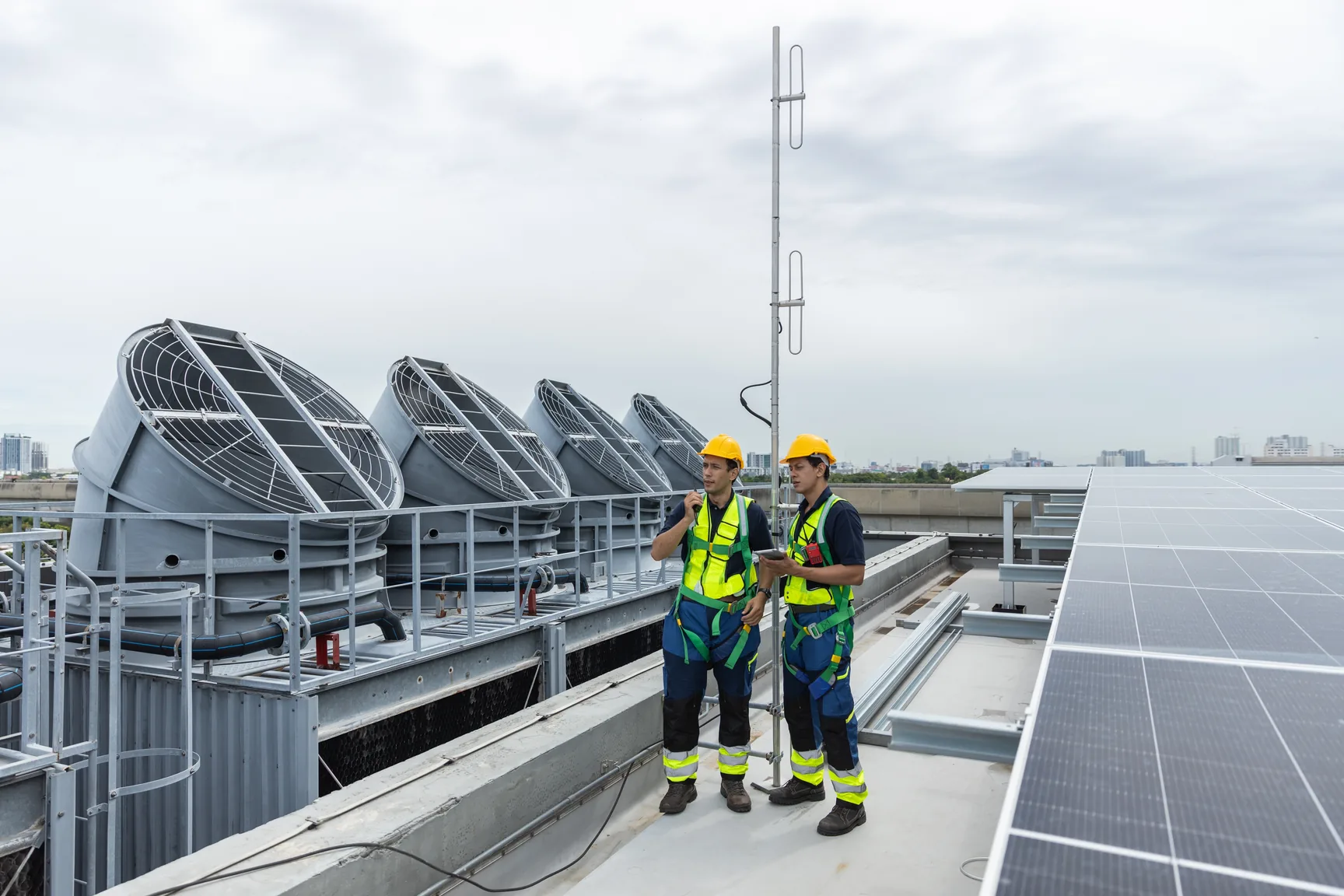
Florida licenses solar contractors itself: the Construction Industry Licensing Board certifies or registers them, and wiring beyond the minor residential work a solar license allows belongs to a contractor licensed by the Electrical Contractors’ Licensing Board. The electrical rules on the job come through the Florida Building Code, which takes in the National Electrical Code statewide, though the edition in force is not confirmed at the state level. A disclosure law written for distributed energy generation, not for solar by name, governs household sales and leases, and workers’ compensation is compulsory for construction employers, with no state fund.
The license question is settled by the state rather than at the county counter, so the harder questions sit at the edges: how far a solar license reaches into the electrical work, which contracts carry the disclosure statement, and which edition an inspector reads from. The sections below take each in turn, quoting the statutes where the exact words matter and marking advice as advice.
How the policies themselves respond to a solar loss anywhere is set out on the solar contractor insurance page and the coverage pages it links to. This page keeps to what is particular to Florida, whether your business does rooftop installation, runs panel cleaning and maintenance routes or takes on ground-mount and solar farm construction.
A stack of layers under a household solar job in Florida, read from the top down. At the top is the written disclosure statement the buyer or lessee acknowledges, required by a sales law written for distributed energy generation rather than for solar by name, and not required for systems on nonresidential property. Beneath it is the state solar contractor license, certified for the whole state or registered on a local competency license, unless another state contracting license already covers the work. Next is the electrical contractor’s license, because a solar license allows only minor electrical work on residential solar equipment and the rest of the wiring and the tie-in go to an electrical licensee. Below that are the electrical requirements of the Florida Building Code, which takes in the National Electrical Code statewide, with the edition in force not confirmed at the state level. At the bottom is compulsory workers’ compensation for construction employers, secured through an authorized insurer or approval to pay benefits directly, with no state fund and a residual-market plan of insurers for employers the voluntary market will not cover. No figures are shown.
A state solar contractor license, certified or registered
Florida licenses solar contractors statewide. Its contracting law defines a solar contractor as one who installs, alters, repairs, maintains, relocates or replaces solar panels for solar water heating, pool heating and photovoltaic systems, and requires certification or registration before anyone engages in the business of contracting. The Construction Industry Licensing Board lists solar among the categories that require it.
A solar installer holds a certified solar contractor license, good anywhere in the state, or a registered one tied to a local competency license, unless another state contracting license already covers the work. Electrical wiring is licensed separately by the Electrical Contractors’ Licensing Board: a solar contractor may do only minor electrical work on residential solar equipment within its own license, and the rest of the wiring and the tie-in go to a licensed electrical contractor.
Authority: Fla. Stat. § 489.105(3)(o); § 489.113(2), (3)(f); § 489.505(12); § 489.531(1)
The contracting law’s definition of the trade is broader than photovoltaics. In the statute’s words, a solar contractor
“means a contractor whose services consist of the installation, alteration, repair, maintenance, relocation, or replacement of solar panels for potable solar water heating systems, swimming pool solar heating systems, and photovoltaic systems”
The license is a condition of doing the work for pay, not a mark of distinction. The section on qualifications says so without qualification:
“A person must be certified or registered in order to engage in the business of contracting in this state.”
The Construction Industry Licensing Board, which certifies and registers solar contractors and the other construction categories, sets solar among the categories that require its license in the answers it publishes for applicants:
“The following categories require registration or certification: general; building; residential; sheet metal; roofing; air-conditioning; mechanical; swimming pool/spa; plumbing; underground utility and excavation; solar and pollutant storage.”
The difference between the forms of the license matters as soon as your crews leave home. A certified license is the statewide credential; a registered license is tied to a local competency license and carries that limit with it. As advice, if your work takes you into counties you have not worked before, ask each building department whether it accepts your license before the proposal goes out, and keep a copy of the license in every permit packet.
A contractor licensed under the same law in another category is spared the solar license for work inside its own license’s scope. The statute says such a contractor
“is not required to become a certified or registered solar contractor or to contract with a solar contractor in order to provide services enumerated in this paragraph that are within the scope of the services such contractors may render under this part.”
That route matters when a general or residential contractor brings you onto its job. As advice, settle whose license the permit is pulled under before the job starts and write it into the subcontract.
How a liability policy treats damage your crews cause to a roof or a building, and the trades you bring in, is set out on the general liability page.
Where the solar license stops and the electrical license begins
A solar license carries some electrical work with it, but not much, and only on homes. The contracting law draws the allowance this way:
“A solar contractor shall not be required to subcontract minor, as defined by board rule, electrical, mechanical, plumbing, or roofing work so long as that work is within the scope of the license held by the solar contractor”
The quoted words leave the meaning of minor to a board rule, and the sentence goes on to confine the allowance to residential solar energy equipment. That board rule is not quoted on this page, so treat the boundary as something to confirm rather than assume: ask the board how it draws the line before a crew decides that a job’s wiring is minor.
On the electrical side, the department’s plain-language page for the public leaves little room:
“If you pay someone to perform even the simplest of electrical work, such as connecting two wires, you must hire a licensee.”
Even the statute’s narrow exemption for an owner putting rooftop solar on a home keeps the wiring with an electrical licensee:
“However, an owner must utilize a licensed electrical contractor to effectuate the wiring of the solar panels, including any interconnection to the customer’s residential electrical wiring.”
Commercial roofs and ground-mounted arrays fall outside the residential allowance altogether. On those jobs, plan on a contractor licensed by the Electrical Contractors’ Licensing Board for the wiring and the tie-in, whether that contractor is on your payroll or under subcontract. Some practical habits follow, offered as advice:
- Know which person in your business holds the electrical license, and what happens to your pipeline if that person leaves.
- When you subcontract the tie-in, collect the electrical contractor’s license number along with its certificate of insurance, and check that the name on each matches the name on the permit.
- On a commercial or ground-mount job, write into the scope which party wires the array, which party makes the interconnection and which party signs for the inspection.
A fire or a fault traced to the tie-in is where the split between your work and the electrician’s gets tested, and the general liability page explains how completed work and subcontracted work are treated.
The disclosure statement in a Florida household solar sale
Florida’s Distributed Energy Generation System Sales law, Part II of chapter 520, requires every agreement to sell or lease a distributed energy generation system to carry a separate written disclosure statement, acknowledged by the buyer or lessee, that includes the installer’s and any maintenance provider’s valid state contractor license number, the total cost, the payment schedule, savings assumptions and the party responsible for interconnection approval.
Authority: Fla. Stat. §§ 520.20–520.26
The law does not name solar. It is written for distributed energy generation systems, and a rooftop array sold or leased to a household is the kind of system it reaches. Its central requirement reads:
“Each agreement governing the sale or lease of a distributed energy generation system shall, at a minimum, include a written statement”
The statement’s list is long, and much of it is about money. Among the items, these speak to the contractor’s side of the job:
“The name, address, telephone number, e-mail address, and valid state contractor license number of the person responsible for installing the distributed energy generation system.”
“A disclosure notifying the buyer or lessee of the party responsible for obtaining interconnection approval.”
The law then ties the sale back to the contracting license:
“A seller that is also an installer must be licensed under chapter 489.”
The Florida Department of Business and Professional Regulation licenses contractors through its construction and electrical boards and enforces the distributed energy generation sales disclosure law. As advice, if you sell your own jobs, build the statement into your contract template rather than attaching it at the kitchen table, and keep the signed acknowledgment with the job file. The license number on the statement is your business’s, so check it on every contract, including the ones a salesperson writes in the field.
The line on interconnection approval deserves particular care. Whoever the statement names as responsible should be the party that actually files with the utility, because a delay in that approval is where a customer starts looking for someone to blame. The professional liability page explains how a policy treats an estimate, a design or a paperwork error that costs a customer money without damaging anything.
Commercial roofs, cash sales and the installer who does not sell
A seller that also installs must be licensed under the contracting law and must meet the department’s safety standards. The disclosure does not apply to systems installed on nonresidential property, to sales paid in full by installation or delivery, or to an installer that is not the seller, so it reaches the residential sale, which is where a rooftop installer that sells its own jobs meets it.
The exemptions that draw those edges are short. The statute sets aside
“The sale or lease of a distributed energy generation system that will be installed on nonresidential real property.”
and, separately,
“A person, other than the seller or lessor, who installs a distributed energy generation system on residential property.”
The installer exemption matters to a business that installs for a sales company or a financing outfit. The disclosure duty falls on the seller, not on you. As advice, ask the seller for a copy of the statement on every job you install, because your license number and your name are on it, and a promise the seller made about output or about who handles the utility will reach your crew on the roof whether or not you wrote it.
A business that builds only on nonresidential property sits outside the statement, but a building owner relies on your output estimate as much as a homeowner does, so put the same subjects in writing anyway.
The Florida Building Code and an electrical edition left unconfirmed
Florida adopts the National Electrical Code statewide through the Florida Building Code, which the Florida Building Commission adopts by rule and updates on a regular cycle; state law directs the Commission to use the National Electrical Code for those updates. The edition in force is set out in the code volumes and the adopting rule, and no state source read for this page names it.
Solar wiring on a Florida building is built to the electrical code the Florida Building Code adopts, enforced by local building departments. The Commission is moving to a new edition of the Building Code, and its own schedule shows that update still awaiting its final rule hearing.
Authority: Fla. Stat. § 553.73; Rule 61G20-1.001, F.A.C.
The statute that governs the Building Code names the National Electrical Code among the models the Florida Building Commission draws on:
“The commission shall use the International Codes published by the International Code Council, the National Electric Code (NFPA 70), or other nationally adopted model codes and standards for updates to the Florida Building Code.”
What is not confirmed at the state level on this page is which edition of that code is in force. The edition is printed in the code volumes and the adopting rule, which this page does not quote, so it names no edition rather than guess. The code still applies statewide; only the edition is left for the building department to confirm.
As advice, the practical answer comes from the permitting office. Ask the building department that will issue the permit which edition its inspectors apply, and for a job permitted while the Commission’s update is pending, which edition will govern on the permit date. Keep the answer with the permit and make sure each crew lead knows it.
A wiring fault that shows up after the job is signed off is a completed-work question, explained on the general liability page.
Construction employers and the duty to secure comp
Workers’ compensation is compulsory in Florida for the employers its law covers, and the construction industry is reached at a lower employee threshold than other private work. An employer secures it by insuring with an authorized stock or mutual company, association or exchange, or by qualifying with the state to pay compensation directly. There is no state fund.
Any contractor or subcontractor doing public or private construction in Florida must secure compensation for its employees, and a contractor answers for a subcontractor’s employees when the subcontractor has not secured it. A residual-market plan of insurers serves employers the voluntary market will not cover.
Authority: Fla. Stat. § 440.02; § 440.10(1); § 440.38(1)
The security section sets out an employer’s options, starting with insurance:
“Every employer shall secure the payment of compensation under this chapter: (a) By insuring and keeping insured the payment of such compensation with any stock company or mutual company or association or exchange, authorized to do business in the state;”
Construction gets its own sentence in the liability section:
“Any contractor or subcontractor who engages in any public or private construction in the state shall secure and maintain compensation for his or her employees under this chapter as provided in s. 440.38”
The definition of employment sets a lower bar for construction than for other private work. Its construction clause reads:
“with respect to the construction industry, all private employment in which one or more employees are employed by the same employer.”
There is no state fund. For the employer the voluntary market will not take, the obligation sentence above points to a residual-market plan of insurers. It is described here by what it does rather than by name, and its statute is explicit that it is no arm of the state:
“Each joint underwriting plan or association created under this section is not a state agency, board, or commission.”
As advice for a solar business: arrange coverage before anyone on the payroll goes up a ladder, collect a certificate from every subcontractor before its people start, and treat a lapsed certificate as a stop-work issue, since the contractor answers for an uninsured subcontractor’s employees. How roof crews, ground crews and service technicians are classified, and how the audit treats subcontractors, are policy questions set out on the workers’ compensation page. Nothing on this page reaches past Florida’s border.
Florida pairs a solar-specialty license with compulsory comp and no named state fund. The work itself is addressed by OSHA’s Fall Prevention Campaign: plan the job, provide the equipment, train the crew.
Florida offices behind each finding
The Florida Office of Insurance Regulation is the state’s insurance regulator; approves the residual-market plan for workers’ compensation. Any agency that sells you a policy, this agency among them, can be looked up on NIPR.com.
The other state bodies this page draws on each hold a separate piece. Each link goes to the body’s own site, and each role is given as our research verified it:
- Florida Department of Business and Professional Regulation: licenses contractors through its construction and electrical boards and enforces the distributed energy generation sales disclosure law
- Construction Industry Licensing Board: certifies and registers solar contractors and the other construction categories
- Electrical Contractors’ Licensing Board: certifies and registers electrical contractors, whose license reaches the wiring and tie-in beyond a solar contractor’s minor electrical work
- Florida Building Commission: adopts and updates the Florida Building Code, which adopts the National Electrical Code statewide
- Florida Department of Financial Services, Division of Workers’ Compensation: workers’ compensation administration, coverage compliance and self-insurance authorization
Permits and inspections still happen locally, through the building department where each job sits.
Metropolitan Florida, as the Census Bureau draws it
The cards below show the largest metropolitan areas with a principal city in Florida, as the U.S. Census Bureau delineates them, and the Florida counties inside each.
Miami-Fort Lauderdale-West Palm Beach, FL
Made up of Broward County, Miami-Dade County and Palm Beach County.
Tampa-St. Petersburg-Clearwater, FL
Made up of Hernando County, Hillsborough County, Pasco County and Pinellas County.
Orlando-Kissimmee-Sanford, FL
Made up of Lake County, Orange County, Osceola County and Seminole County.
Jacksonville, FL
Made up of Baker County, Clay County, Duval County, Nassau County and St. Johns County.
North Port-Bradenton-Sarasota, FL
Made up of Manatee County and Sarasota County.
Cape Coral-Fort Myers, FL
Made up of Lee County.
A certified solar license travels across all of these counties; a registered license may not. As advice, if your crews work in more than the home metro, keep a list of the counties you price jobs in, note which ones accept your license, and confirm each county’s permit requirements before the proposal goes out.
From Florida’s rules to the policies that answer for the work
The findings above say where Florida’s rules sit. The policies that answer for the work are the ones a solar business carries wherever it works, and each has its own page:
- The solar license, the electrical license and the trades you subcontract point to general liability, which also takes up finished wiring and damage to the roof or building under the array.
- The disclosure statement’s savings assumptions and the interconnection line point to professional liability, for estimates, designs and paperwork a customer relied on.
- The compulsory comp law for construction employers points to workers’ compensation.
- Trucks and trailers carrying modules and racking between the yard and the job point to commercial auto.
- Meters, lifts and equipment on the way to the roof point to tools and equipment.
- Commercial contracts that ask for limits above the primary layer point to umbrella liability.
Which of those weigh heaviest depends on the work, and the pages on rooftop installation, panel cleaning and maintenance and ground-mount and solar farm construction take each kind of work on its own terms. When you are ready to put the pieces together for Florida jobs, a quote request is the place to start.
State rules decide who may do the work and how; the policies decide who pays when something goes wrong.
- A license, registration or certification is a requirement of the state, not insurance.
- Electrical code is not confirmed at the state level on this page.
A panel for Florida in rows. Each row sets a requirement of the state beside the exposure that requirement leaves open and the coverage line that answers it. License to install: A state license reaches solar installation. It leaves open damage to the roof, the building or a neighbor’s property from the installation work, which General Liability answers. Solar sales and installer rules: The state sets its own rules for solar sellers, installers or providers. It leaves open a design, sizing or output estimate the customer relied on that turns out wrong, which Professional Liability answers. Electrical code: Not confirmed at the state level. No connector is drawn for this row. Workers’ compensation: Required for covered employers, bought in the open market. It leaves open a crew member hurt on the job, which Workers’ Compensation answers. Notes: A license, registration or certification is a requirement of the state, not insurance. Electrical code is not confirmed at the state level on this page. The conclusion reads: State rules decide who may do the work and how; the policies decide who pays when something goes wrong. No figures are shown.
Florida coverage, services and state offices
What we insure
Coverage lines
Florida solar contractor insurance questions
Our solar license is registered through our home county. Can we take a job on the far side of Florida?
Check before you bid. A registered solar license rests on a local competency license, while a certified license from the Construction Industry Licensing Board is good anywhere in the state. With a registered license, ask the building department where the job sits whether it accepts yours. If you expect to work across many counties, ask the board what moving to a certified license would take.
How much of the wiring can our solar crew do before we need a licensed electrical contractor?
Only minor electrical work, as a board rule defines it, within your own license and exclusively on residential solar energy equipment. Everything beyond that, the tie-in included, goes to a contractor licensed by the Electrical Contractors’ Licensing Board. The rule that defines minor is not quoted on this page, so ask the board where it draws the line before a crew decides for itself.
We finance and lease rooftop systems to homeowners. What does the agreement have to include?
A separate written disclosure statement the buyer or lessee acknowledges, listing among other things the installer’s valid state contractor license number, the total cost, the payment schedule, the savings assumptions and who is responsible for interconnection approval. The law speaks of distributed energy generation systems rather than solar. Build the statement into your contract template and have it reviewed before the season starts.
We only build arrays on warehouses and offices. Does the disclosure law touch our contracts?
The law exempts the sale or lease of a system installed on nonresidential real property, so a purely commercial book sits outside its disclosure statement. That is no reason to drop the habits it encourages. A commercial owner still relies on your output estimate and on whoever handles the utility’s approval, so put each in writing, with the assumptions behind each figure.
The Building Code is in the middle of an update. How do we know which electrical rules apply to a job we are pricing now?
Ask the building department that will issue the permit. The Florida Building Commission adopts the Florida Building Code, which takes in the National Electrical Code statewide, but the edition in force is not confirmed at the state level on this page, and the Commission’s schedule shows a new Building Code edition still waiting on its final rule hearing. Get the inspector’s answer with the permit.
A subcontracted crew on our roof has no workers’ compensation. Is that our problem?
It can be. Under Florida law a contractor answers for a subcontractor’s employees when the subcontractor has not secured compensation for them. Collect a current certificate from every subcontractor before its people climb your ladder, check that it names the right business, and diary the expiration. Keep every certificate where you can find it again when your own policy is audited.
No insurer in the voluntary market will write our crew. Where does a Florida solar business go for workers’ compensation?
Florida has no state fund. A residual-market plan of insurers serves employers the voluntary market will not cover, and its statute says it is not a state agency. An employer may also qualify to pay compensation directly, which the Florida Department of Financial Services, Division of Workers’ Compensation administers. An agency that works the market can tell you which path fits before your crew goes back on a roof.
This page describes insurance for solar contractors operating in this state. It is general information, not legal advice and not a statement of coverage. Licensing, interconnection and code requirements change; verify current requirements with the agency named before relying on them.
Get a quote for your Florida solar contracting business
Tell us whether your Florida license is certified or registered, who holds the electrical license on your jobs and whether you sell to households, and we will build the program from there.