
Solar Contractor Insurance by State
Washington Solar Contractor Insurance
Washington reaches solar work through the electrical contractor license, regulates the installation contract in a consumer chapter written for residential and commercial customers, adopts the electrical code statewide, and makes workers’ compensation a state fund matter, with self-insurance as the alternative.
Washington has no license written only for solar, and it does not need one: the Washington State Department of Labor & Industries issues an electrical contractor license, and the chapter on solar consumer protections names solar installation and design as work that needs it. The people doing the wiring hold electrician certificates, the electrical code is adopted for the whole state with a newer edition adopted but not yet in effect, and workers’ compensation is monopolistic, bought from the state fund or covered by qualifying as a self-insurer, with no private insurer in the middle.
A solar contractor reading this page will meet connected duties in different corners of the Revised Code. The license is the gate to bidding and installing, the consumer chapter governs the contract that follows, and the comp statute decides where the payroll is insured. The sections below take them in that order, with the sources’ own words where they matter and advice for the owner whose name is on the paperwork.
How the policies themselves work for a solar business anywhere is laid out on the solar contractor insurance page and the coverage pages it links to. This page keeps to what is particular to Washington, whether your business does rooftop installation, runs panel cleaning and maintenance routes or takes on ground-mount and solar farm construction.
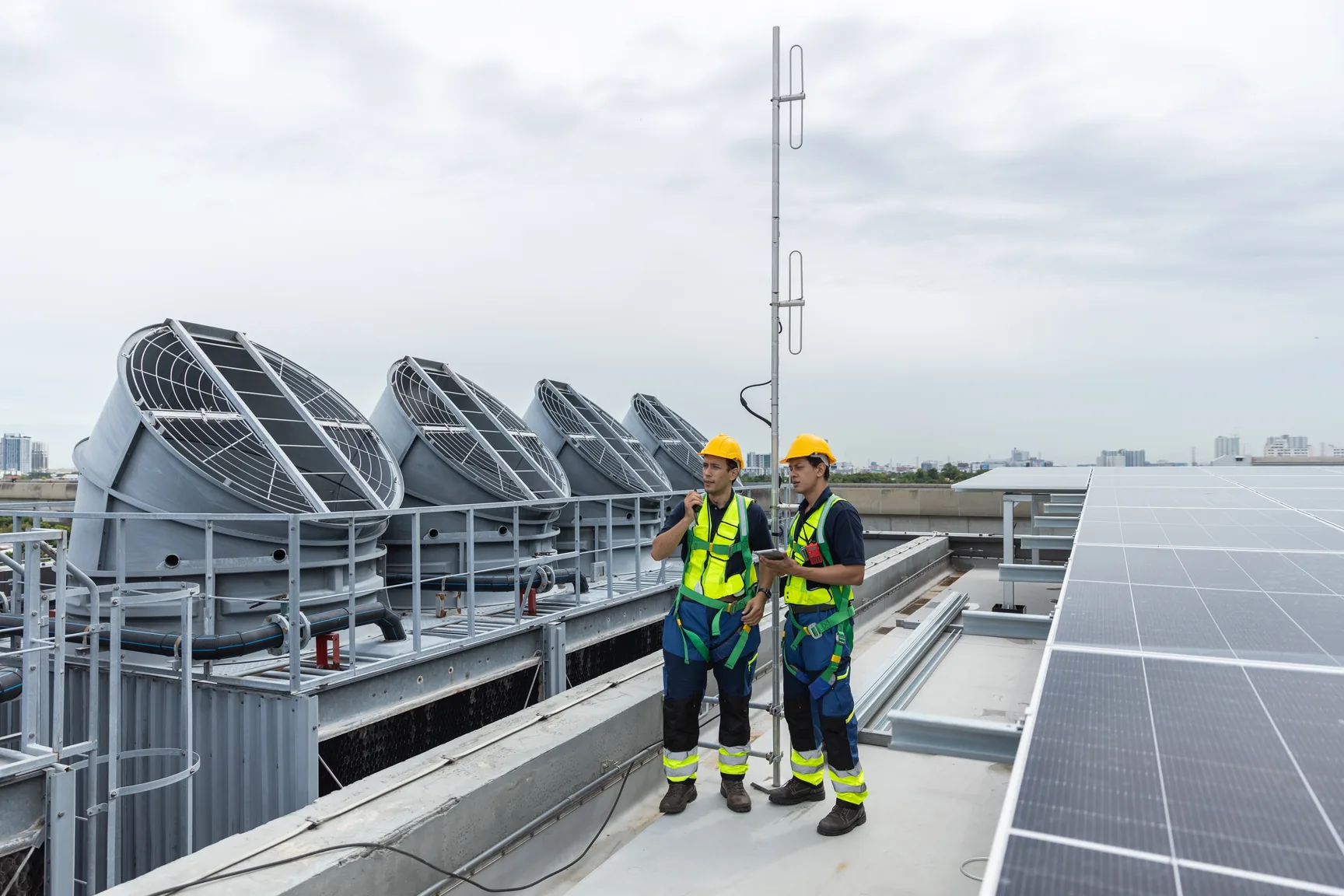
A stack of layers under a Washington solar job, read from the top down. At the top is the state electrical contractor license, which the solar consumer chapter ties to solar installation and design and which the Department of Labor and Industries issues. Beneath it is the crew: certified electricians on the wiring, while racking and mounting alone may sit with a registered general contractor and every connection and termination stays with the electrical contractor. Next is the written installation contract the consumer chapter requires, with a dealer fee disclosure and utility approval of the interconnection application before installation begins, for residential and commercial customers alike. Below that is the electrical code adopted for the whole state, with a newer edition already adopted that is not yet in effect. At the bottom is workers’ compensation, which is monopolistic: the state fund, or qualification with the Department as a self-insurer, and no private insurer. No figures are shown.
An electrical contractor license that solar work cannot skip
Washington requires a state electrical contractor license for solar installation. The Department of Labor & Industries issues it, the Solar Energy Consumer Protections chapter names solar installation and design as work that needs it, and the people doing the wiring must hold electrician certificates of competency. Washington has no separate solar license.
A solar contractor in Washington holds an electrical contractor license from the Department of Labor & Industries before it advertises, bids or installs a rooftop or ground-mounted system, has certified electricians (or supervised trainees) do the wiring, and registers as a contractor with the same Department. Racking and mounting alone may be done by a registered general contractor, but every connection and termination belongs to the electrical contractor.
Authority: RCW 19.28.041; RCW 19.95.020(1)–(2); RCW 18.27.020; WAC 296-46B-690; WAC 296-46B-940
The duty starts in the chapter on electricians and electrical installations, in a sentence that reaches advertising and bidding, not only the work itself:
“It is unlawful for any person, firm, partnership, corporation, or other entity to advertise, offer to do work, submit a bid, engage in, conduct, or carry on the business of installing or maintaining wires or equipment to convey electric current”
The solar chapter does not create a license of its own. It points back to the license in the sentence above, and the subsection that does so ends with these words:
“must be licensed as provided in RCW 19.28.041”
The same chapter says who counts as a solar energy contractor, and the definition covers design as well as installation:
“a person, partnership, corporation, or other entity that designs, installs, repairs, replaces, or maintains solar energy systems.”
Read together, these quotations settle what an owner would otherwise have to guess. A firm that sells and installs arrays holds the license. A firm that only designs them is within the same definition. As advice, check before the next proposal goes out that the license is current and held in the legal name that signs the contract, and keep the license number on every bid, subcontract and advertisement your business sends out.
How a liability policy treats damage your crews cause to a roof or a building, and the electricians and roofers you subcontract, is set out on the general liability page.
The hands on the roof: certified electricians, racking crews and the registered contractor
A license held by the company is only part of the picture, because the rule on certificates reaches the individual. The Department’s rule opens with a display requirement for anyone in the electrical construction trade:
“To work in the electrical construction trade, an individual must possess, wear, and visibly display on the front of the upper body, a current valid:”
The finding above names the credential that requirement points to for the wiring crew: an electrician certificate of competency. The Department’s state photovoltaic rule then divides the work on a photovoltaic installation. It reserves the electrical side this way:
“All electrical work, including wiring installation, terminations, etc., necessary to complete the electrical installations must be completed by the entity authorized to do the electrical work (i.e., owner or appropriate electrical contractor).”
And it says who may build the structure under the equipment:
“Such structural support or foundation may be done by the owner, registered general contractor, or licensed electrical contractor without electrical permit or inspection.”
The line the rule draws is practical. Racking and mounting alone may be done by a registered general contractor, but every connection and termination belongs to the electrical contractor. A separate duty sits in the contractor registration chapter, which opens with a short command:
“Every contractor shall register with the department.”
The finding above says the registration is a general construction registration, not a solar credential, so it does not replace the electrical contractor license for the wiring. For an owner, the working rules look like this:
- Ask every subcontractor that sets racking, flashing or foundations for its registration with the Department, and keep a copy with the job file.
- Put the wiring scope in the subcontract in the electrical contractor’s name and have the license number written beside it, so the paper shows who was authorized to do the electrical work.
- Make sure each person who lands a conductor wears the certificate the rule describes, on every crew and every day, not only when the Department’s inspector is expected.
Because the structure and the wiring are separate scopes, the gap between them is where a dispute can start. A mount that leaks and a conductor that fails can be traced to the same roof. Your agent can explain how general liability responds to a subcontractor’s work, and the tools and equipment page takes up the modules, inverters and racking on their way to the roof.
The contract chapter: written terms, dealer fees and utility approval
Washington’s Solar Energy Consumer Protections chapter, RCW 19.95, regulates the sale and installation of residential or commercial solar energy systems. It requires a license for solar installation and design work, a written installation contract with a long list of required terms and disclosures, a customer right to cancel, utility interconnection approval before installation begins, and bans deceptive solicitation.
Authority: RCW 19.95.005–19.95.040
The chapter protects a defined person. In its own words, the customer is
“a residential or commercial property owner or leaseholder who is solicited by or signs a contract with a solar energy salesperson or a solar energy contractor for a residential or commercial solar energy system.”
The chapter binds the solar energy contractor and any salesperson who solicits for it, on residential or commercial customers alike. The contract must itemize the work, the financing and any dealer fee paid to a lender, the equipment and its warranties, the production projection and the roofing costs, and the contractor must have the utility approve the interconnection application before installing. A violation is an unfair or deceptive act under the state consumer protection act, and the contractor is liable to the customer for actual damages.
The license requirement inside the chapter is the electrical contractor license already described above; it is the same duty, not an added one. What the chapter adds is the sales and contract side. Its installation contract section begins with a plain rule of form:
“A solar energy installation contract must be in writing”
Among the items the contract has to carry is a disclosure that matters when a lender is involved:
“Disclosure of the exact amount paid, if any, by a solar energy contractor or solar energy salesperson to any lender or third-party financing company in the form of a dealer fee”
The chapter also fixes the order of events on the job. The utility’s approval comes before the crew begins:
“The interconnection application for the solar energy system must be approved by the applicable electric utility before the solar energy contractor or the subcontractor begins installing the system.”
For a contractor, that sentence turns the interconnection application into a gate on the schedule. A crew that mobilizes before the utility has approved the application is working against the statute’s order. As advice, track the approval in the job file with the same care as the permit, and tell the sales team that a date promised to a customer should account for it.
What a violation costs, and who in the business needs to read the chapter
The chapter binds more than the owner. It reaches salespeople who solicit for the contractor, and it bans deceptive solicitation in so many words:
“No person may solicit using any statement or representation with regard to the costs, financing, terms, or conditions of purchase or installation of residential or commercial solar energy systems that is deceptive.”
The consequence is written into the chapter as well:
“A violation of this chapter is not reasonable in relation to the development and preservation of business and is an unfair or deceptive act in trade or commerce”
The finding above adds that the contractor is liable to the customer for actual damages. A consumer protection claim can follow a sales conversation as well as a defective installation, and it can come from a commercial customer as well as a household, because the chapter’s customer definition covers a residential or a commercial property owner. The excerpts on this page do not draw a line between an ordinary commercial customer and a very large project, so a contractor bidding a large commercial job should read the chapter’s definitions in full before relying on any assumption about its reach.
Some habits make that exposure easier to live with. They are advice, not rules the state has adopted:
- Give salespeople the chapter. A representation about costs, financing or terms is where the solicitation ban applies. Put the permitted statements in writing and review them with every new hire.
- Keep the financing story consistent. If a lender or finance company is involved, the dealer fee disclosure should match what the sales team says aloud.
- Produce the projection with care. The contract itemizes the production projection, so the assumptions behind it deserve the same attention as the price. The professional liability page explains how a policy treats a shortfall claim where nothing was damaged.
- Ask your agent, in writing, what is covered. A statutory claim for damages is not the same as bodily injury or property damage, and the answer for your program belongs in the file.
The adopted code, and a newer edition that is adopted but not yet in effect
Washington adopts the National Electrical Code statewide through the Department of Labor & Industries’ rule WAC 296-46B-010, and adds its own photovoltaic rule, WAC 296-46B-690, covering design review, who may place and secure equipment, who must do the electrical work, and how maximum voltage is calculated. The rule has already adopted a newer edition with a later effective date.
Solar wiring in Washington is built to the adopted National Electrical Code as the Department’s rule amends it, with the state’s photovoltaic rule applied on top, and the Department’s inspectors or an authorized city inspect it under an electrical permit. The newer edition the rule names replaces the current edition on a date the rule itself states.
Authority: WAC 296-46B-010(1); WAC 296-46B-690
The adopting rule takes the national code in by reference. Its adopted standards section names the edition now in effect:
“The 2023 edition of the National Electrical Code (NFPA 70 - 2023) including Annex A, B, C, and subsequent Errata and Tentative Interim Amendments issued by the National Fire Protection Association”
The same section also looks ahead. It adopts a newer edition, and the clause states when the change comes:
“Effective December 31, 2026, the 2026 edition of the National Electrical Code (NFPA 70-2026) including Annex A, B, and C is adopted in this chapter by reference and replaces the 2023 edition of the NFPA 70.”
That is an unusual position for an owner to plan around: the newer edition is adopted and not yet in effect. Until the date the rule gives arrives, the edition named in the adopted standards quotation is the code in force, and the newer one is a scheduled replacement rather than a draft. As advice, do not wait for the date to start asking questions. A design that depends on a provision found only in the newer edition, or a job whose permit falls close to the changeover, should be settled with the inspecting office in writing before the work.
On top of the national code sits the state’s own photovoltaic rule. The finding above lists what it covers: the design review, who may place and secure equipment, who must do the electrical work and how maximum voltage is calculated. One of its requirements is easy to overlook, because it concerns paper, not wiring:
“A photovoltaic system design review defined in WAC 296-46B-100 must be available at the installation site at the time of the first inspection and until the inspection process is complete.”
How a liability policy treats a wiring fault that comes to light after the job is finished is explained on the general liability page.
Comp through the state fund, or as a self-insurer the Department qualifies
Workers’ compensation in Washington is monopolistic. A covered employer secures it only through the state fund, which the Department of Labor & Industries runs, or by qualifying with the Department as a self-insurer. The private insurance market does not write it.
A solar contractor with employees insures its workers’ compensation with the state fund, or qualifies with the Department of Labor & Industries to self-insure. The electrical contractor license application asks for evidence of that coverage.
Authority: RCW 51.14.010; RCW 51.16.060; RCW 51.08.175; RCW 51.14.020(1); RCW 19.28.041(1)(d)
The statute states the duty and the routes to meet it in the same breath:
“Every employer under this title shall secure the payment of compensation under this title by: (1) Insuring and keeping insured the payment of such benefits with the state fund; or (2) Qualifying as a self-insurer under this title.”
The routes are not offered on equal footing with a private market, because no private route appears. Another section of the Revised Code describes what every employer that does not qualify as a self-insurer has to do:
“every employer not qualifying as a self-insurer, shall insure with the state”
The fund the statute means is a public one. Its definition section describes State of Washington industrial insurance fund this way:
“means the department when acting as the agency to insure the industrial insurance obligation of employers.”
The alternative to the fund is self-insurance, which the record types as allowed. The statute sets the test:
“An employer may qualify as a self-insurer by establishing to the director's satisfaction that he or she has sufficient financial ability to make certain the prompt payment of all compensation under this title”
Comp is also part of the license file. The electrical contractor license application asks for it:
“Evidence of workers' compensation coverage for the applicant's employees working in Washington”
The Washington State Department of Labor & Industries issues electrical contractor licenses and electrician certificates, registers contractors, adopts and enforces the state electrical code, and runs the state fund for workers’ compensation, so the office that licenses the company is the office that insures its payroll. As advice, treat the license and the coverage as a shared calendar: arrange the coverage before the license is filed, and collect a certificate from every subcontractor before its people set foot on an array. Classification, audits and subcontractor pay are set out on the workers’ compensation page. Nothing here reaches past Washington’s border, so for a job in a neighboring state, check that state’s rules before the crew goes.
Washington runs comp through a named state fund, and the Washington State Department of Labor & Industries is listed below. The crew’s work at height has a separate federal reference in OSHA’s Fall Prevention Campaign.
The Department, the insurance commissioner and the Legislature’s code site
The Office of the Insurance Commissioner is the state’s insurance regulator. Any agency that sells you a policy, this agency among them, can be looked up on NIPR.com.
The bodies below carry the rest of this page. The Department licenses, certifies, registers, inspects and insures; the Legislature’s site publishes the text. Each link goes to the body’s own site, and each role is as the record gives it:
- Washington State Department of Labor & Industries: issues electrical contractor licenses and electrician certificates, registers contractors, adopts and enforces the state electrical code, and runs the state fund for workers’ compensation
- Washington State Legislature: publishes the Revised Code of Washington and the Washington Administrative Code
Absent on purpose: a license written for solar alone, and a private market for workers’ compensation. When a rule is in doubt, the Legislature’s code site is where the statutes and rules quoted above can be read in full.
Where the Census puts Washington’s metro counties
The cards below show the largest metropolitan areas with a principal city in Washington, as the U.S. Census Bureau delineates them, and the Washington counties inside each.
Seattle-Tacoma-Bellevue, WA
Made up of King County, Pierce County and Snohomish County.
Portland-Vancouver-Hillsboro, OR-WA
Part of this metro lies outside Washington; this card lists its Washington counties only: Clark County and Skamania County.
Spokane-Spokane Valley, WA
Made up of Spokane County and Stevens County.
Kennewick-Richland, WA
Made up of Benton County and Franklin County.
Olympia-Lacey-Tumwater, WA
Made up of Thurston County.
Bremerton-Silverdale-Port Orchard, WA
Made up of Kitsap County.
The license, the certificate and the comp fund are statewide, so a crew that moves from one metro to the next carries the same obligations with it. What changes is the office that permits and inspects the job. As advice, record for every job the county and the city, and ask the inspecting office which electrical code edition it will apply before the proposal goes out.
Pairing a license, a contract and a payroll with the policies behind them
The findings above say where Washington’s rules sit. The policies that answer for the work are the ones a solar business carries wherever it works, and each has its own page:
- The electrical contractor license, the subcontractors you bring in and the finished wiring point to general liability, which also takes up damage to the roof or building under the array.
- The contract chapter’s written projection and its solicitation ban point to professional liability, for estimates and designs a customer relied on.
- The state fund and the self-insurer route point to workers’ compensation, where the policy side of classification and audit is explained.
- Trucks and trailers that carry modules and racking between the yard and the job point to commercial auto.
- Modules, inverters and your own gear on the way to the roof point to tools and equipment.
- Contracts that ask for limits above the primary layer point to umbrella liability.
Which of those weigh heaviest depends on the work, and the pages on rooftop installation, panel cleaning and maintenance and ground-mount and solar farm construction take each kind of work on its own terms. When you are ready to put the pieces together for Washington jobs, a quote request is the place to start.
State rules decide who may do the work and how; the policies decide who pays when something goes wrong.
- A license, registration or certification is a requirement of the state, not insurance.
- In this state, workers’ comp comes from the state fund (or approved self-insurance); we place the rest of your coverage.
A panel for Washington in rows. Each row sets a requirement of the state beside the exposure that requirement leaves open and the coverage line that answers it. License to install: A state license reaches solar installation. It leaves open damage to the roof, the building or a neighbor’s property from the installation work, which General Liability answers. Solar sales and installer rules: The state sets its own rules for solar sellers, installers or providers. It leaves open a design, sizing or output estimate the customer relied on that turns out wrong, which Professional Liability answers. Electrical code: The state adopts the National Electrical Code statewide. It leaves open a wiring or tie-in fault traced back to the work after the job is done, which General Liability answers. Workers’ compensation: Bought from the state fund, or self-insured with the state’s approval. No connector is drawn for this row. Notes: A license, registration or certification is a requirement of the state, not insurance. In this state, workers’ comp comes from the state fund (or approved self-insurance); we place the rest of your coverage. The conclusion reads: State rules decide who may do the work and how; the policies decide who pays when something goes wrong. No figures are shown.
Washington coverage, services and state offices
What we insure
Coverage lines
Washington solar contractor insurance questions
Do we need an electrical contractor license just to advertise or bid a rooftop job?
Yes, if the work is solar installation or design. The Revised Code makes it unlawful to advertise, offer to do work or submit a bid for installing or maintaining wiring or equipment that conveys electric current without the license, and the solar chapter ties solar installation and design to that same license. The Washington State Department of Labor & Industries issues it, so confirm that it is active before any proposal goes out.
Our crew only sets rails and modules and never lands a conductor. Does that crew need the license?
The photovoltaic rule lets the owner, a registered general contractor or a licensed electrical contractor do the structural support or foundation without an electrical permit or inspection. Every wiring installation and termination belongs to the entity authorized to do electrical work. Draw the line in the subcontract, so the crew that mounts the equipment and the crew that wires it are each named and each properly licensed or registered.
Does the solar consumer chapter apply when our customer is a business rather than a household?
It can. The chapter defines a customer as a residential or commercial property owner or leaseholder, and its duties attach to residential or commercial solar energy systems. A written contract, a dealer fee disclosure and utility approval of the interconnection application before installation all appear in it. The excerpts here do not draw a line for very large projects, so read the definitions in full before bidding such a project.
Can a Washington solar contractor buy workers’ compensation from a private insurer?
No. The statute gives a covered employer a choice of the state fund or qualifying as a self-insurer, and names no private insurer. The Department runs State of Washington industrial insurance fund, and the license application asks for evidence of coverage for the applicant’s employees working in the state. Arrange the coverage before anyone on the payroll climbs a ladder, and have the evidence ready when the license comes up for filing.
What does it take to qualify as a self-insurer instead of using the state fund?
The statute lets an employer qualify by establishing to the director’s satisfaction that it has sufficient financial ability to pay all compensation. That is a showing to the Washington State Department of Labor & Industries, not a purchase from an insurer. A small solar contractor should weigh it against the fund with its accountant, and ask the Department what it requires before assuming the route is open.
Which electrical code will an inspector use on our array, and is a newer edition coming?
The edition the Department’s adopted standards rule names today, with the state’s own photovoltaic rule applied on top of it. That same rule has already adopted a newer edition that replaces the current one on a date the rule states, and that edition is adopted but not yet in effect. For a permit that falls near the changeover, ask the inspecting office which edition it will apply.
Who regulates the insurance side of our program, and how do we check an agency’s license?
The Office of the Insurance Commissioner is the state’s insurance regulator, and an agency’s license, ours included, can be looked up on NIPR.com. Workers’ compensation sits with the Department rather than with the commissioner or a private insurer, so expect the rest of the program, such as liability, auto and equipment, to be placed through an agency while the comp coverage is arranged with the state fund.
This page describes insurance for solar contractors operating in this state. It is general information, not legal advice and not a statement of coverage. Licensing, interconnection and code requirements change; verify current requirements with the agency named before relying on them.
Get a quote for your Washington solar contracting business
Tell us who holds your electrical contractor license, which Washington counties your crews work in and how your crew is paid, and we will shape a program around those answers.