
Solar Contractor Insurance by State
North Carolina Solar Contractor Insurance
North Carolina treats photovoltaic installation as electrical contracting under a statewide board license, certifies the lessors that lease solar systems to customers, wires to a state code that keeps houses on an earlier edition, and makes comp compulsory for covered employers.
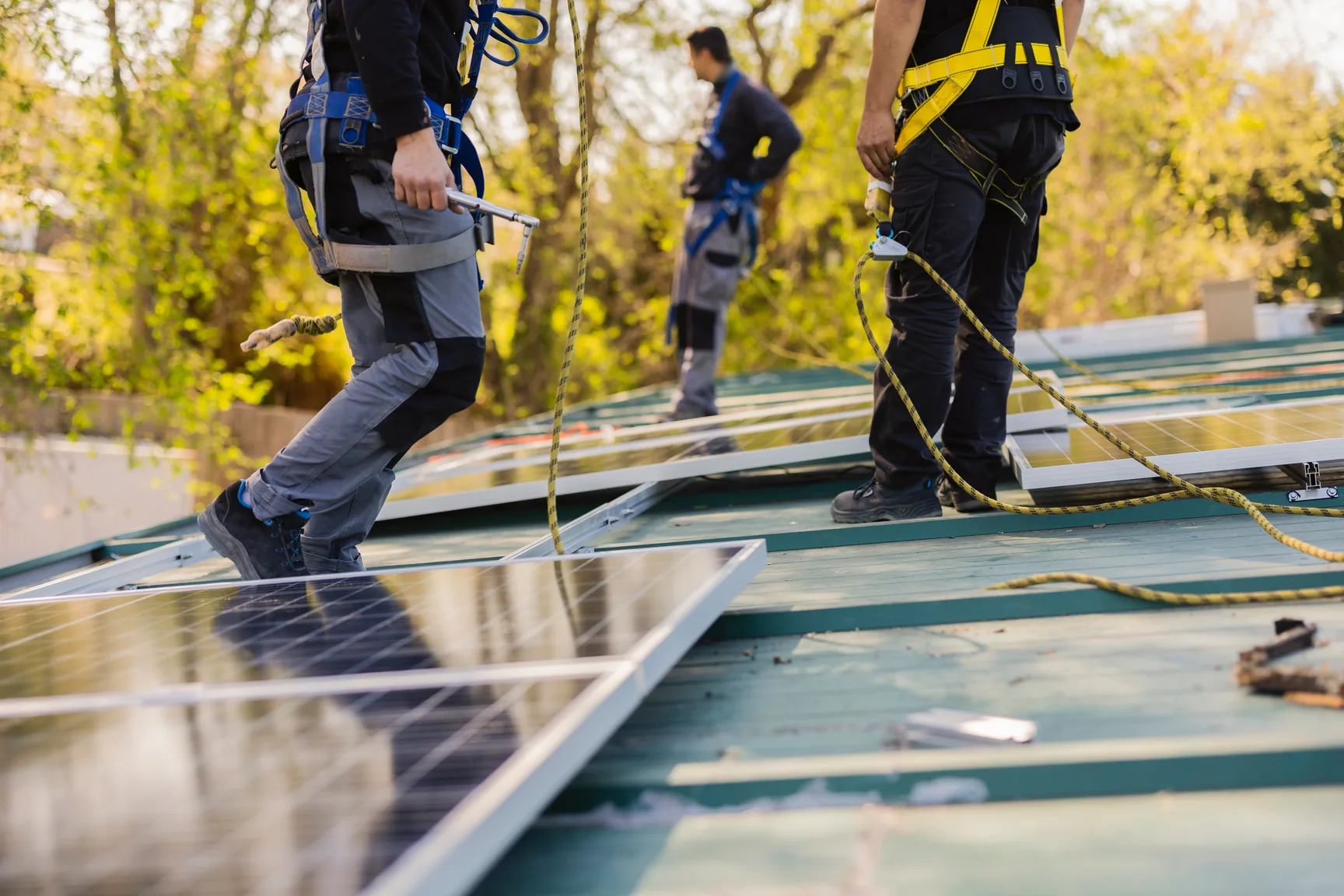
North Carolina reads a solar install as electrical contracting: the State Board of Examiners of Electrical Contractors licenses every business that installs electric work or equipment, and its solar guidance says a photovoltaic installation of any value needs that license, though the Board keeps no solar class. The wiring is built to the state electrical code the North Carolina Building Code Council adopts, which leaves detached houses, duplexes and townhouses within the residential code on an earlier edition. The state’s solar-specific rules fall on the lessor that leases a system to a customer, through a certificate from the North Carolina Utilities Commission, and workers’ compensation is compulsory for covered employers, with no state fund.
That makes the electrical license the hinge of a North Carolina solar business: which classification the company holds, who supervises under it, and who on the crew works as the licensee’s employee.
How the policies behave for a solar business anywhere is laid out on the solar contractor insurance page and the coverage pages it links to. What follows stays with North Carolina, whether your crews do rooftop installation, run panel cleaning and maintenance routes or take on ground-mount and solar farm construction.
A relationship diagram with a North Carolina solar installing company at the center. From the company, labeled lines run to each state rule it meets: it contracts under an electrical contractor license from the electrical contractors board, which reaches photovoltaic work of any value and has no solar class; it keeps a listed qualified individual on duty to supervise the work done under that license; it may staff the job with crew members on its own payroll, since a bona fide employee of a licensee is outside the licensing article; it adds a general contractor license only when the job takes in structural or general construction work above the statutory threshold; it falls outside the lessor’s certificate and lease contents rules when it only installs, because those rules reach the lessor and the agents acting for it; it wires to the state electrical code, with houses, duplexes and townhouses within the residential code kept on the earlier code; and it answers for compulsory workers’ compensation with no state fund, including the injured workers of a subcontractor hired without a certificate of coverage. No figures are shown.
Electrical contracting that takes in every photovoltaic install
North Carolina licenses solar installation through its electrical contractor law. The State Board of Examiners of Electrical Contractors licenses every business that installs, maintains, alters or repairs electric work or equipment, and the Board’s solar guidance says a solar photovoltaic installation of any value requires an electrical contractor license. The Board has no separate solar or photovoltaic license class.
A solar installer contracts the work under a Board license in a classification sized to the project — limited, intermediate or unlimited, or the residential dwelling class for wiring on a detached house — with a listed qualified individual supervising the work, and crew members work as employees of the licensee. A general contractor license comes in only when the job adds structural or other general construction work above the general contracting threshold.
Authority: G.S. 87-43; G.S. 87-43.1; G.S. 87-43.3; G.S. 87-43.4; 21 NCAC 18B .0801, .0803; G.S. 87-1; G.S. 87-10
The statute’s definition is written about electric work and equipment in general, with no list of trades:
“Electrical contracting shall be defined as engaging or offering to engage in the business of installing, maintaining, altering or repairing any electric work, wiring, devices, appliances or equipment.”
The licensing bar follows from it:
“No person, partnership, firm or corporation shall engage, or offer to engage, in the business of electrical contracting within the State of North Carolina without having received a license in the applicable classification described in G.S. 87-43.3”
The State Board of Examiners of Electrical Contractors applies that definition to solar in its published guidance, which is the Board’s reading rather than the statute:
“Solar Photovoltaic installations of any value requires an electrical contractor license.”
As advice, choose the classification against the largest projects you expect to bid, not the average roof, and keep the qualified individual’s listing current with the Board. Damage to the roof under an array, or to the building around it, is taken up on the general liability page.
The dwelling class, the payroll exception and the general contractor line
The Board’s residential dwelling class is narrower than its regular classifications. Its rule describes what the license
“authorizes the licensee to install, maintain, or repair only electrical wiring and devices that are in or on a single family residential dwelling or are ancillary to a single family residential dwelling.”
As advice, a company holding only that class should screen each lead before it bids: a townhouse row or a small office may sit outside a license written for a house and the structures that serve it.
The crew question turns on a short exception. The licensing article does not apply
“To any person in the course of his work as a bona fide employee of a licensee of this Board.”
That exception lets installers without licenses of their own set racking and pull wire, provided they are the licensee’s employees working under the listed qualified individual. As advice, keep laborers from a staffing firm, or paid as independent contractors, off the electrical side of a job until the Board has said how it views them.
The Board’s guidance also reports how the North Carolina Licensing Board for General Contractors sees a solar job. That board
“considers SPVP Installations to be electrical work unless the scope of work to be performed includes structural or other improvements”
A general contractor license enters a solar job only through that structural or general construction work, above a value the statute sets, and there is no separate home improvement license to add. As advice, when a bid includes new framing or a carport canopy rather than racking alone, ask the general contractors’ board whether your scope crosses its line.
A certificate to lease a solar facility to a customer
North Carolina’s Distributed Resources Access Act regulates the leasing of solar energy facilities. Nobody may lease a solar facility to a customer without a certificate from the North Carolina Utilities Commission, and every lease must be signed and dated by the customer, give a right to rescind, describe the equipment with a production guarantee, set out the full costs, and carry disclosures about transfer restrictions and changing utility rates.
Authority: G.S. 62-126.3; G.S. 62-126.5; G.S. 62-126.6; G.S. 62-126.7; NCUC Rule R8-73
This law names solar outright. Its central bar reads:
“No person shall engage in the leasing of a solar energy facility without having applied for and obtained a certificate authorizing those operations from the Commission.”
The duty falls on the electric generator lessor — the owner that leases the system to the customer, and agents acting for it — not on a contractor hired only to install. The Commission’s rule reaches anyone who owns and leases a system, holds itself out as able to, or solicits a lease, and asks the lessor to show it can obtain and keep adequate insurance protection. The Act covers leased systems at homes and businesses alike, and it does not allow the system owner to sell the electricity directly to the customer.
The statute defines the lessor this way:
“The owner of solar energy facility that leases the facility to a customer generator lessee, including any agents who act on behalf of the electric generator lessor.”
The North Carolina Utilities Commission rule then reaches beyond ownership to the people who sell leases. It applies to any offering utility
“or any other person or entity who owns and leases a solar energy facility to another person, holds itself out as doing so or able to do so, solicits another person to enter into a lease of a solar facility”
An applicant for the certificate shows, among other things, that it is
“financially solvent, able to obtain and continue adequate insurance protection, and able to maintain its equipment in a safe, dependable manner”
For a contractor hired only to install, the certificate is the lessor’s business. The picture changes when your company owns the systems it places, or when your sales staff present a lessor’s lease and collect signatures on it. As advice, if that describes your company, read the rule with your attorney before the next lease goes out.
What a lease’s production guarantee asks of the installing crew
Among the contents the statute requires of every lease is this:
“Provide a description of the solar energy facility, including the make and model of the solar energy facility's major components, and a guarantee concerning energy production output that the solar energy facility will provide over the expected life of the agreement.”
Because the law reaches residential and nonresidential customers, a lease on a warehouse roof carries the same contents as a lease on a house. The lease is the lessor’s document, but its description and its output guarantee rest on work your crew does. What follows is advice, not a state rule:
- The equipment named in the lease. Install the make and model the lease describes, and get the lessor’s written approval before any substitution goes up, so the customer’s document still matches the roof.
- The production assumptions. Ask the lessor where its guarantee comes from. If your design sets those numbers, a shortfall can come back to your company; the professional liability page explains how a policy treats an estimate a customer relied on.
- The insurance clauses. A lessor that must show it can keep adequate insurance protection may pass insurance terms down to its installers. Read the additional insured, indemnity and limit clauses beside the general liability and umbrella liability pages before you sign.
A state electrical code that keeps houses on an earlier edition
North Carolina adopts the National Electrical Code as the North Carolina Electrical Code, a volume of the State Building Code adopted by the Building Code Council, with state amendments that leave the solar photovoltaic article as printed. The current code leaves out detached houses, duplexes and townhouses within the residential code’s scope, which stay under the earlier State Electrical Code, and a newer edition is adopted but delayed by statute.
Solar wiring on a commercial, industrial or multifamily building is permitted and inspected by the local inspections department to the current code; on a house, duplex or townhouse within the residential code it is built to the earlier code, and rooftop residential systems follow the State Electrical Division’s statewide inspection procedure, which the Division says is not optional.
Authority: G.S. 143-138; North Carolina Electrical Code, 2020 edition, Sections 10.1–10.2; S.L. 2025-2, s. 5.12
The statewide reach comes from the building code statute:
“Except as otherwise provided in this section, the North Carolina State Building Code shall apply throughout the State, from the time of its adoption.”
The North Carolina Office of State Fire Marshal lists the current code with this note, and the amendments it points to say where that code stops:
“(2020 NEC with State Amendments; excluding one- and two-family dwellings, see Amendments 10.1 & 10.2)”
“This code shall not apply to one- and two-family dwellings. The 2017 State Electrical Code shall apply to one- and two-family dwellings.”
A contractor working across the state may wire to different editions in the same week: apartments, offices and warehouses under the current code, and detached houses, duplexes and townhouses within the residential code under the earlier code. The state amendments leave the solar photovoltaic article as printed. As advice, mark the governing code on every job ticket.
A newer edition has also been adopted, and a statute has delayed its start indefinitely; it is not in effect, and the codes applied to permits remain the ones quoted above. As advice, if a design leans on a provision found only in the newer edition, settle it with the inspections department before the permit application goes in.
Rooftop arrays on houses carry an added layer: the Office’s statewide inspection procedure for residential rooftop photovoltaic systems, which leaves no room for local preference:
“The provisions of this document are not optional. No inspections department shall knowingly disregard the provisions within this document.”
As advice, keep the procedure with your design standards. A fault in finished wiring that surfaces after the inspection is a liability question, taken up on the general liability page.
Comp for the crew, and the subcontractor without a certificate
Workers’ compensation is compulsory in North Carolina for the employers the Workers’ Compensation Act covers, which turns on how many people a business regularly employs. A covered employer insures with an authorized insurer or a group-employer mutual association, or is licensed to self-insure by the Commissioner of Insurance. There is no state fund; coverage comes from the private market.
A solar contractor with employees carries a North Carolina workers’ compensation policy or qualifies to self-insure, and a contractor that sublets work without getting the subcontractor’s certificate of coverage is liable for that subcontractor’s injured workers, however small the subcontractor’s crew.
Authority: G.S. 97-93(a); G.S. 97-2(1); G.S. 97-19
The Act’s security section gives a covered employer a choice of routes. It may
“Insure and keep insured his liability under this Article in any authorized corporation, association, organization, or in any mutual insurance association formed by a group of employers so authorized; or”
or it may
“Obtain a license from the Commissioner of Insurance under Article 5 of this Chapter or under Article 47 of Chapter 58 of the General Statutes.”
Whether the Act reaches an employer at all depends on its definition of employment, which takes in
“all private employments in which three or more employees are regularly employed in the same business or establishment”
The North Carolina Industrial Commission puts the duty in plain terms:
“A business covered by the North Carolina Workers' Compensation Act, Chapter 97 of the North Carolina General Statutes, is required by law to obtain workers’ compensation insurance or qualify as a self-insured employer.”
For a solar contractor the sharpest edge is the subcontractor clause. A contractor that sublets work without obtaining the subcontractor’s certificate of coverage
“shall be liable, irrespective of whether such subcontractor has regularly in service fewer than three employees in the same business within this State”
As advice, collect a current certificate from every subcontractor, the small electrical firm and the trenching crew included, before its people reach the site, and file it with the subcontract. With no state fund, the policy comes from an authorized insurer in the private market unless the company qualifies to self-insure; crew classification and audits are set out on the workers’ compensation page.
North Carolina’s electrical license comes from a state board, and the North Carolina Industrial Commission is listed below. Roof and ladder work also has a federal reference in OSHA’s Fall Prevention Campaign.
The licensing boards, commissions and code offices behind each rule
The North Carolina Department of Insurance is the state’s insurance regulator; the Commissioner of Insurance licenses self-insured employers for workers’ compensation, and the department houses the Office of State Fire Marshal. Any agency that sells you a policy, this agency among them, can be looked up on NIPR.com.
The other public bodies on this page, each linked to its own site and described by its role:
- State Board of Examiners of Electrical Contractors: licenses electrical contractors statewide, the license that reaches solar photovoltaic installation
- North Carolina Licensing Board for General Contractors: licenses general contractors, needed on a solar job only for structural or general construction work above the statutory threshold
- North Carolina Office of State Fire Marshal: publishes the state building codes and, through its State Electrical Division, the electrical code amendments, interpretations and the residential rooftop solar inspection procedure
- North Carolina Building Code Council: adopts and amends the State Building Code, including the North Carolina Electrical Code
- North Carolina Utilities Commission: certifies electric generator lessors that lease solar energy facilities to customers and enforces the solar lease requirements
- North Carolina Industrial Commission: workers’ compensation administration and employer coverage compliance
Day to day, the electrical board holds your license and the local inspections department permits and inspects the work; the North Carolina Utilities Commission matters only if you lease systems or sell leases.
The counties each North Carolina metro takes in
These cards follow the largest metropolitan areas that take in North Carolina counties, as the U.S. Census Bureau delineates them, and name the North Carolina counties each contains.
Charlotte-Concord-Gastonia, NC-SC
This metro extends past the state line; the card names its North Carolina counties only: Anson County, Cabarrus County, Gaston County, Iredell County, Lincoln County, Mecklenburg County, Rowan County and Union County.
Raleigh-Cary, NC
Its counties: Franklin County, Johnston County and Wake County.
Greensboro-High Point, NC
Its counties: Guilford County, Randolph County and Rockingham County.
Winston-Salem, NC
Its counties: Davidson County, Davie County, Forsyth County, Stokes County and Yadkin County.
Durham-Chapel Hill, NC
Its counties: Chatham County, Durham County, Orange County and Person County.
Wilmington, NC
Its counties: Brunswick County, New Hanover County and Pender County.
The electrical license travels with your company from county to county; what changes is the inspections department and, on a house, the code edition it applies. As advice, record the county and the building type for every job you price.
A North Carolina solar program, line by line
The rules above settle who may do the work and to what standard. When the work goes wrong, each policy that responds has its own page:
- Work done under the electrical license, on the roof and in the finished wiring: general liability.
- The output guarantee in a lessor’s lease, and any design you supply for it: professional liability.
- Compulsory comp and the subcontractor clause: workers’ compensation.
- Vans and trailers carrying inverters, conduit and racking to the site: commercial auto.
- Meters, lifts and modules waiting on the site: tools and equipment.
- Lessor and developer agreements that ask for higher limits: umbrella liability.
How much each line matters depends on the work itself, and the pages on rooftop installation, panel cleaning and maintenance and ground-mount and solar farm construction take each kind on its own terms. A quote request is where a North Carolina program starts.
State rules decide who may do the work and how; the policies decide who pays when something goes wrong.
- A license, registration or certification is a requirement of the state, not insurance.
A panel for North Carolina in rows. Each row sets a requirement of the state beside the exposure that requirement leaves open and the coverage line that answers it. License to install: A state license reaches solar installation. It leaves open damage to the roof, the building or a neighbor’s property from the installation work, which General Liability answers. Solar sales and installer rules: The state sets its own rules for solar sellers, installers or providers. It leaves open a design, sizing or output estimate the customer relied on that turns out wrong, which Professional Liability answers. Electrical code: The state names the National Electrical Code in part; local codes govern the rest. It leaves open a wiring or tie-in fault traced back to the work after the job is done, which General Liability answers. Workers’ compensation: Required for covered employers, bought in the open market. It leaves open a crew member hurt on the job, which Workers’ Compensation answers. Notes: A license, registration or certification is a requirement of the state, not insurance. The conclusion reads: State rules decide who may do the work and how; the policies decide who pays when something goes wrong. No figures are shown.
Nearby states we also write
North Carolina coverage, services and state offices
What we insure
Coverage lines
Outside authorities
North Carolina solar contractor insurance questions
We do nothing but solar. Which North Carolina license does our company need before it signs a contract?
An electrical contractor license. The State Board of Examiners of Electrical Contractors licenses electrical contracting statewide, and its solar guidance says a photovoltaic installation of any value needs that license. Its rules hold no solar or photovoltaic class, so you apply for a regular classification sized to your projects, or the residential dwelling class if your work stays on detached houses. Each place of business also keeps a listed qualified individual supervising the work.
Our racking crew is on our payroll and holds no licenses. Can they work on a North Carolina array?
The electrical licensing article does not apply to a person working as a bona fide employee of a licensee, so a crew on your own payroll can work under your company’s license with the qualified individual supervising. As advice, keep laborers from a staffing firm or paid as independent contractors off the wiring until the State Board of Examiners of Electrical Contractors has told you how it views them, and keep its answer in writing.
When does a solar job in North Carolina also call for a general contractor license?
The electrical board’s guidance reports that the North Carolina Licensing Board for General Contractors treats a photovoltaic installation as electrical work unless the scope adds structural or other general construction improvements. A general contractor license comes in only when that added work reaches the value the statute sets. As advice, when a bid includes new framing or a canopy rather than racking alone, ask that board before you price the job.
A leasing company owns the systems we install and leases them to its customers. Is the lease certificate our obligation?
The certificate falls on the lessor, the owner that leases the system and any agents acting for it, not on a contractor hired only to install. The North Carolina Utilities Commission rule also reaches anyone who solicits a lease, so if your sales staff present the lessor’s lease to customers, settle in writing with the lessor and your attorney whether that makes your company its agent.
Which electrical code applies to an array on a duplex, and which applies on an apartment building?
The current state code leaves out detached houses, duplexes and townhouses within the residential code, and those stay under the earlier code; apartments and other multifamily buildings are built to the current code. A newer edition has been adopted, but a statute has delayed it indefinitely and it is not in effect. Ask the local inspections department which code it will apply before the design is final.
Is there a statewide way that inspectors check a rooftop array on a house?
Yes. The North Carolina Office of State Fire Marshal, through its electrical division, publishes a statewide inspection procedure for photovoltaic systems on residential rooftops, and the document says its provisions are not optional and that no inspections department shall knowingly disregard them. As advice, read it with your designers and crew leads, and build the job file around what an inspector following it will ask to see.
We sublet electrical work to a small firm. Could its injured workers become our problem?
They could. The state’s comp law makes a contractor that sublets work without getting the subcontractor’s certificate of coverage liable for that subcontractor’s injured workers, however small its crew. The North Carolina Industrial Commission administers that law. As advice, collect a current certificate before the subcontractor’s people reach the site, check it at each renewal, and keep it with the subcontract.
This page describes insurance for solar contractors operating in this state. It is general information, not legal advice and not a statement of coverage. Licensing, interconnection and code requirements change; verify current requirements with the agency named before relying on them.
Get a quote for your North Carolina solar contracting business
Tell us the electrical classification your company holds, whether you install for a leasing company, and which North Carolina counties your crews work in, and we will shape a program around those answers.