
Solar Contractor Insurance by State
Kansas Solar Contractor Insurance
Kansas leaves electrician and contractor licensing to its counties and cities, requires a separate disclosure before a home energy system contract, adopts an electrical code through a fire marshal regulation while letting local governments adopt their own, and makes workers’ compensation compulsory with no state fund.
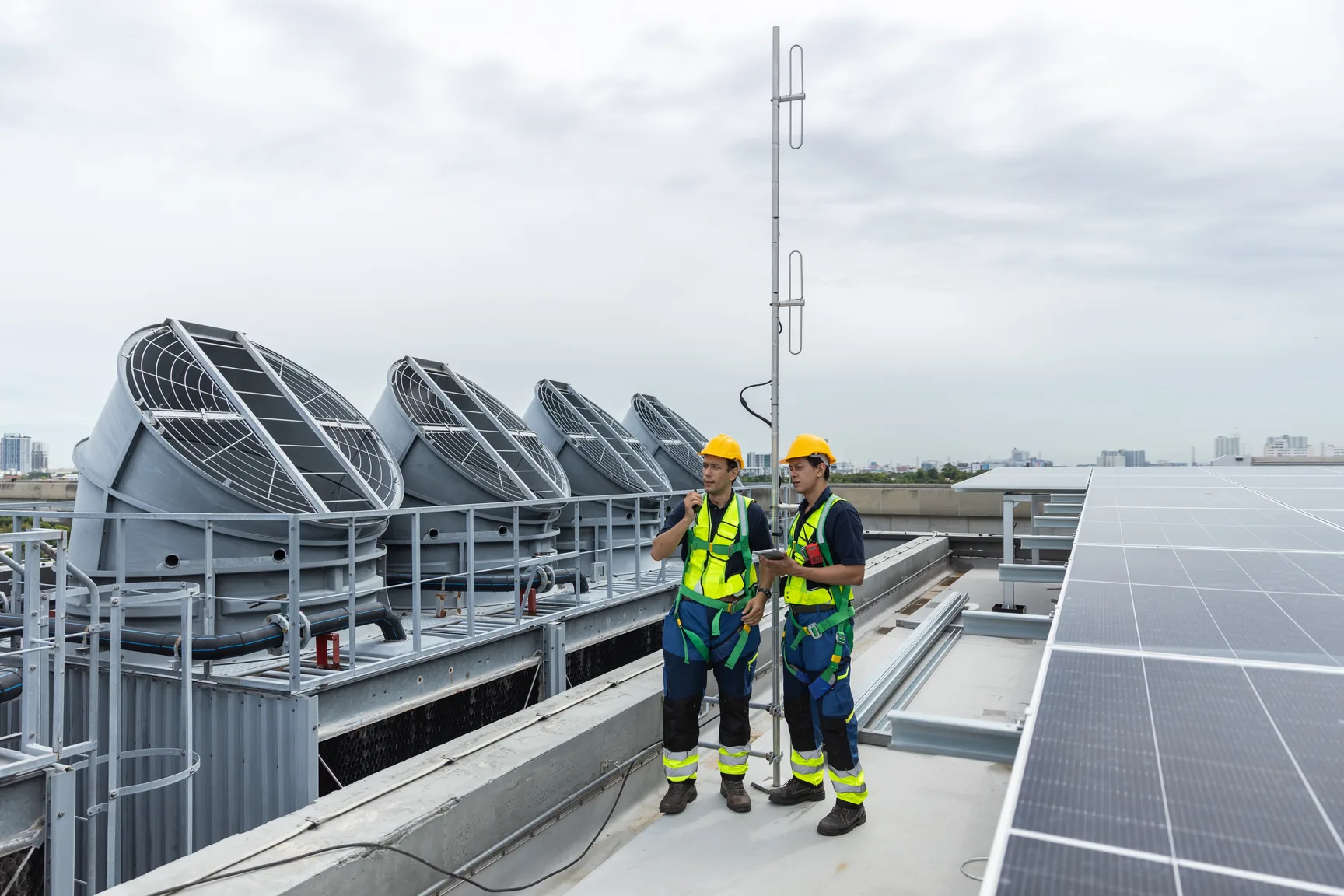
A contract to sell a Kansas homeowner a distributed energy system is void when the seller skips the separate disclosure document the statute requires before signing, and that document must name the certified practitioner, or the master electrician or electrical contractor, who will oversee the installation. Behind that name stands a state that licenses no electrician or electrical contractor of its own: a license that reaches an array’s wiring comes from the county or city where the job sits, and it does not follow the holder beyond that place. The wiring is built to a national electrical code adopted by a regulation of the Office of the State Fire Marshal, while a county or city may adopt a code of its own, and workers’ compensation is compulsory, secured through a carrier, self-insurance or a group-funded pool, with no state fund writing it.
The edges of each finding matter as much as the finding. The disclosure law is written for distributed energy systems rather than for solar by name, and for owners of homes and small multifamily buildings alone. The statewide roofing registration is silent on whether it reaches an array. How far the fire marshal’s code reaches against a local code is not confirmed. The sections below take each in turn, with the statutes’ own words where they matter and advice for the owner.
How the policies themselves work for a solar business anywhere is laid out on the solar contractor insurance page and the coverage pages it links to. This page keeps to what is particular to Kansas, whether your business does rooftop installation, runs panel cleaning and maintenance routes or takes on ground-mount and solar farm construction.
A two-column comparison. The left column holds what the state sets for the whole state: a separate disclosure document that must come before a home energy system contract, naming the certified practitioner or the electrician overseeing the installation, with a contract made without it void; an electrical code adopted by a State Fire Marshal regulation as part of the fire prevention code; and compulsory workers’ compensation, met through an authorized carrier, self-insurance or a group-funded pool, with no state fund. The right column holds what stays local or unsettled: electrician licensing, granted by a county or city and honored only where it was granted; the power of a county or city to adopt its own electrical code; how far the fire marshal’s code and a local code each reach, which is not confirmed; and the statewide roofing registration, whose definition does not say whether it reaches rooftop solar. No figures are shown.
Electrician licenses granted by a county or city and honored only there
Kansas has no statewide license for solar installation or electrical work. The licensing power sits with each county and city: a county or city that requires electricians to be licensed examines and licenses them, sets its own electrical code and inspects, and a license granted on a local examination does not reach work outside the place that granted it.
A solar contractor’s electrical licensing therefore comes from the county or city where the job sits, and Johnson County, for example, licenses electrical contractors as a class of its contractor license. Separately, a contractor that does roofing work must hold a roofing registration certificate from the Attorney General, and the Act’s definition of a roofing contractor does not mention solar work.
Authority: K.S.A. 12-1525 to 12-1527; K.S.A. 12-1557; K.S.A. 50-6,122; K.S.A. 50-6,123
The Kansas Statutes limit what a license from a local examination is worth:
“licenses granted upon the basis of examinations other than those designated by K.S.A. 12-1525 , and amendments thereto, shall not authorize an electrician to practice outside of the jurisdiction of the city or county granting such license.”
General, building and residential contractors are treated the same way, as a matter for the county or city:
“Any county or city requiring the licensure of general contractors, building contractors and residential contractors practicing within the county or city”
The Johnson County Contractor Licensing shows what that power looks like in use: the county issues contractor licenses in classes that include an electrical class, and a builder obtains the license before applying for a building permit for a project. Its guide to permits and licenses lists the classes:
“Contractor licenses include the following classes: General (A), Building (B), Residential (C), Electrical (DE), Fire Protection (DF and DFA), Mechanical (DM), Plumbing (DP), Roofing (DR), Swimming Pool (DS) and Wood Framing (DW).”
Notice what the list is built around. It is a list of trades, with an electrical class beside a roofing class, and it never names solar. On a solar job the class that matters for the tie-in is the electrical class, so decide before the bid who on the job will hold it, or which licensed electrician your crew will work under, and name that person in the proposal.
Where licensing is set locally, careful record-keeping does the work a statewide credential would:
- Ask the building or licensing office where the job sits whether it requires electricians or contractors to be licensed, which classes it issues, and what it wants on file before a permit issues.
- Keep a file of what each county and city has issued your business and when it lapses. A license from the place where your shop sits says nothing about the next jurisdiction.
- When you subcontract the tie-in, ask the electrician for the local license along with the certificate of insurance, and note which place granted it.
How a liability policy treats the electricians and roofers you subcontract, and damage your crews cause on a roof or in a building, is set out on the general liability page.
The statewide roofing registration and the question its definition leaves open
Kansas does have a credential that applies across the whole state, and it sits on the roof. The statute puts a condition on acting as a roofing contractor:
“No person shall engage in the business of or act in the capacity of a roofing contractor within this state without having a valid registration certificate as required by this act.”
The definition of a roofing contractor decides who needs the certificate, and it reads in part:
“offers to engage in or solicits roofing-related services, including construction, installation, renovation, repair, maintenance, alteration and waterproofing.”
The definition lists installation and maintenance among roofing-related services and does not use the word solar. The statute does not say whether it reaches rooftop solar installation. This page therefore does not say that a crew mounting an array needs the registration, and it does not say that the crew is exempt.
As advice, settle the question before the bid rather than on the roof. Put it in writing to the office that issues the registration, describe the work your crew does on a roof, and keep the answer in the job file. The comp section below takes up the proof of coverage that registering brings.
A separate disclosure before the contract, or the contract is void
Kansas regulates the sale of home solar systems through its distributed energy retailer law. A business that sells, markets, finances or installs a system that feeds excess power to the utility must give a homeowner a separate disclosure document before the contract, must be registered with the Secretary of State where the business-entity law requires it, and loses the contract if it skips the disclosures.
Authority: K.S.A. 50-6,147; K.S.A. 50-6,148; K.S.A. 50-6,149
The law that reaches a home solar sale in Kansas is not a solar law by name. It is a statute on distributed energy retailers, and it defines who counts as a retailer:
“"Distributed energy retailer" means any person or entity that sells, markets, solicits, advertises, finances, installs or otherwise makes available for purchase a distributed energy system in the state of Kansas.”
It protects a defined kind of customer:
“means a property owner of a single-family dwelling or multifamily dwelling of two units or fewer”
A solar contractor selling to an owner of a home or a small multifamily building must hand over the statute’s disclosure document, which names the NABCEP-certified practitioner or the licensed master electrician or electrical contractor overseeing the installation, and must be able to show the permit, the local inspection, the utility’s interconnection approval and permission to operate. The owner signs the document on a later day than the contract, and a contract made without compliance is void. The statute speaks of distributed energy systems under a net metering or parallel generation agreement and does not name solar, which takes in rooftop and ground-mounted solar alike.
The duty itself is written as a document that stands apart from the contract and comes before it:
“Prior to entering into a contract with a distributed energy customer for a distributed energy system, a distributed energy retailer shall provide such customer a separate disclosure document that:”
Among the items that document must carry is the name of the person answerable for the installation:
“includes the name and certification number of the individual certified by the north American board of certified energy practitioners who will oversee the permitting and installation of the distributed energy system”
The statute says what follows when a seller does not comply:
“If a distributed energy retailer fails to comply with this section, any contract entered into between the distributed energy retailer and the distributed energy customer that pertains to the distributed energy system shall be deemed null and void.”
This page covers residential sales only, because the customer the statute defines is an owner of a home or a small multifamily building. It makes no claim about a sale to a business, and the statute does not name solar, which is why the section above speaks of a distributed energy system.
As advice, treat the disclosure as part of the sales process. Decide who will be named as the overseer on each job before the proposal is written, and keep that person’s credentials current. The professional liability page explains how a policy treats an estimate or design a customer relied on.
A fire marshal’s electrical code, a county’s or city’s own, and an overlap not confirmed
Kansas adopts the national electric code through a State Fire Marshal regulation that is part of the Kansas fire prevention code, and the regulation prints an older edition of the code. Counties and cities may also adopt and enforce electrical codes of their own, so the edition that governs a solar job depends on where it sits.
Solar wiring in Kansas is built to the code edition the State Fire Marshal’s regulation adopts, unless the county or city where the job sits has adopted its own electrical code, which state law allows it to do and to inspect against. A contractor confirms the locally adopted edition and the inspecting office before pulling a permit.
Authority: K.A.R. 22-1-3(n); K.S.A. 31-133; K.S.A. 31-134; K.S.A. 12-1527
The adopting regulation is a rule of the Office of the State Fire Marshal. It takes the national electrical code in by reference, in the edition it prints:
“(n) national electric code. NFPA standard no. 70, including annexes A, B, C, D, E, F, G, and H, 2008 edition;”
The statute behind the regulation gives the fire marshal’s rules force across the state:
“Such rules and regulations shall have uniform force and effect throughout the state.”
A different statute gives counties and cities power of their own over electrical work:
“adopt and enforce such electrical codes, standards and regulations as the board of county commissioners or governing body of the city deem appropriate”
Those provisions sit side by side, and the scope of each against the other is not confirmed. This page does not say that the fire marshal’s code is the only code on a Kansas job, and it does not say that a local code displaces it. What can be said is narrower: the regulation adopts a national electrical code in the edition printed above, and a county or city is allowed to adopt and enforce a code it deems appropriate.
As advice, ask the permitting office for the job which code and which edition its inspectors apply, and ask in writing. Put the answer on the drawings and tell each crew lead. How a liability policy treats a fault in completed wiring that comes to light later is explained on the general liability page.
Comp secured through a carrier, self-insurance or a group-funded pool
Workers’ compensation is compulsory in Kansas for the employments its Act covers. An employer secures compensation by insuring with a carrier authorized to write the coverage in Kansas, by showing the director that it can carry its own risk as a self-insurer, or by joining a qualified group-funded pool of employers. No state fund writes coverage for employers; coverage comes from the private market, self-insurance or an employer pool.
A solar contractor with employees carries a workers’ compensation policy from an authorized carrier, qualifies with the director to pay benefits itself, or belongs to a qualified group-funded pool; a roofing contractor registering with the Attorney General must also show coverage, an exemption or self-insurance.
Authority: K.S.A. 44-505(a); K.S.A. 44-532(b)
The security section tells every employer how to meet the duty:
“Every employer shall secure the payment of compensation to the employer's employees by insuring in one of the following ways:”
The routes follow. An employer may insure
“By insuring and keeping insured the payment of such compensation with an insurance carrier authorized to transact the business of workers compensation insurance in the state of Kansas;”
or it may show
“by showing to the director that the employer carries such employer's own risk and is what is known as a self-insurer and by furnishing proof to the director of the employer's financial ability to pay such compensation for the employer's self;”
or it may join a pool:
“by maintaining a membership in a qualified group-funded workers compensation pool.”
The pool statute describes what a pool is, and what it is not:
“All such arrangements shall be known as group-funded workers compensation pools, which shall not be deemed to be insurance or insurance companies”
For a solar business, that leaves the market, the director’s approval or a pool, and no state agency sells the coverage. A carrier route means a policy from an insurer authorized to write workers’ compensation in Kansas, chosen in the private market. A pool route means checking that the pool is qualified before the crew depends on it.
How crews are classified, how subcontractors are treated at audit and how a policy follows a crew that travels are policy questions rather than Kansas questions, set out on the workers’ compensation page. As advice, settle before the season who on each job is your employee, and collect a certificate from every subcontractor before its people set foot on an array. Nothing on this page reaches past Kansas’s border; for a job in a neighboring state, check that state’s rules.
Kansas has no state solar license, and the Kansas Secretary of State and Johnson County are among the files listed below. The federal page for the work itself is OSHA’s Fall Prevention Campaign.
Registration, fire code and county license: who holds which piece
The public bodies behind this page each hold a separate part of the picture. Each link goes to the body’s own site, and each role is the role the body’s own pages give:
- Kansas Secretary of State: registers business entities; a distributed energy retailer that the business-entity law requires to register must be registered and in good standing with the office
- Office of the State Fire Marshal: adopts the Kansas fire prevention code, which adopts the national electric code by reference
- Planning, Housing and Community Development, Johnson County: issues county contractor licenses, including an electrical class, ahead of building permits in the unincorporated county
Absent on purpose: a statewide board that licenses electricians, electrical contractors or solar installers, and a state fund that writes workers’ compensation for employers. In an ordinary week the offices that matter are the building, permitting and licensing departments of the counties and cities where your crews work.
Kansas metros, where a county or city decides who may wire the array
The cards below show the metropolitan areas, as the U.S. Census Bureau delineates them, that include Kansas counties. Metros centered in Kansas come ahead of a metro whose principal city lies in another state, and each card lists the Kansas counties inside it.
Kansas City, MO-KS
Part of this metro lies outside Kansas; this card lists its Kansas counties only: Johnson County, Leavenworth County, Linn County, Miami County and Wyandotte County.
Wichita, KS
Made up of Butler County, Harvey County, Sedgwick County and Sumner County.
Topeka, KS
Made up of Jackson County, Jefferson County, Osage County, Shawnee County and Wabaunsee County.
Manhattan, KS
Made up of Geary County, Pottawatomie County and Riley County.
Lawrence, KS
Made up of Douglas County.
Joplin, MO-KS
Part of this metro lies outside Kansas; this card lists its Kansas counties only: Cherokee County.
Because electrician licensing, contractor licensing and the electrical code can each be set by the county or city where a job sits, a metro area is a set of separate rulebooks rather than a uniform market. As advice, log the county and the city for every job you price, check that place’s rules before the proposal goes out, and do not assume that a license good in a metro’s principal city reaches its suburbs.
Where a Kansas crew’s exposure lands in a policy
The findings above say where Kansas’s rules sit. The policies that answer for the work are the ones a solar business carries wherever it works, and each has its own page:
- Local licensing and the electricians you bring in point to general liability, which also takes up finished wiring and damage to the roof or building under the array.
- The disclosure duty and the estimates and designs behind a home proposal point to professional liability.
- The compulsory comp law points to workers’ compensation, whether it is met through a carrier, self-insurance or a pool.
- Trucks and trailers that carry modules and racking between the yard and the job point to commercial auto.
- Your own gear on the way to the roof points to tools and equipment.
- Contracts that ask for limits above the primary layer point to umbrella liability.
Which of those weigh heaviest depends on the work, and the pages on rooftop installation, panel cleaning and maintenance and ground-mount and solar farm construction take each kind of work on its own terms. When you are ready to put the pieces together for Kansas jobs, a quote request is the place to start.
State rules decide who may do the work and how; the policies decide who pays when something goes wrong.
- A license, registration or certification is a requirement of the state, not insurance.
- Electrical code is not confirmed at the state level on this page.
A panel for Kansas in rows. Each row sets a requirement of the state beside the exposure that requirement leaves open and the coverage line that answers it. License to install: No statewide license; the city or county where the array goes up may license the work. It leaves open damage to the roof, the building or a neighbor’s property from the installation work, which General Liability answers. Solar sales and installer rules: The state sets its own rules for solar sellers, installers or providers. It leaves open a design, sizing or output estimate the customer relied on that turns out wrong, which Professional Liability answers. Electrical code: Not confirmed at the state level. No connector is drawn for this row. Workers’ compensation: Required for covered employers, bought in the open market. It leaves open a crew member hurt on the job, which Workers’ Compensation answers. Notes: A license, registration or certification is a requirement of the state, not insurance. Electrical code is not confirmed at the state level on this page. The conclusion reads: State rules decide who may do the work and how; the policies decide who pays when something goes wrong. No figures are shown.
Kansas coverage, services and state offices
What we insure
Coverage lines
Kansas solar contractor insurance questions
A homeowner’s contract went out without a separate disclosure page. What happens to that contract in Kansas?
The statute says a contract made without compliance is void. It requires a separate disclosure document before the contract, naming the certified practitioner or the master electrician or electrical contractor overseeing the installation. The statute speaks of distributed energy systems and does not name solar, and it covers owners of homes and small multifamily buildings. Put the document in the packet before anyone signs, and keep a dated copy.
Our electrician passed a city’s examination. Can that license put the crew to work in the next county?
Not on that license alone. A license granted on a local examination does not authorize work outside the city or county that granted it, and the state itself licenses no electricians or electrical contractors. Ask the office in the county where the job sits what it requires, ask whether the places involved have an agreement between them, and put the answer in the bid before the crew mobilizes.
Our crew sets racking and modules on roofs. Does the statewide roofing registration cover or require that work?
The statute does not say whether the roofing registration reaches rooftop solar installation. Its definition lists installation and maintenance among roofing-related services and never uses the word solar. A roofing contractor must hold the registration certificate, and the application asks for proof of workers’ compensation coverage, an exemption or self-insurance. Ask the issuing office in writing before you bid a roof.
A city we bid in has adopted an electrical code of its own, and the fire marshal’s regulation adopts a national code as well. Which do we draw to?
Ask the city’s permitting office. State law lets a county or city adopt and enforce the electrical codes it deems appropriate, and the rules of the Office of the State Fire Marshal have uniform force throughout the state. How far each code reaches against the other is not confirmed, so get the controlling edition in writing from the inspecting office before the drawings are final.
Can our crew be covered through a group-funded pool instead of an insurance policy?
Yes, the statute lists pool membership among the routes. An employer may insure with an authorized carrier, show the director that it carries its own risk, or maintain membership in a qualified group-funded pool, which the statute says is not insurance or an insurance company. No state fund writes the coverage, so confirm that a pool is qualified before you rely on its membership.
We also sell rooftop systems to businesses. Does the Kansas disclosure law reach those sales?
This page covers residential sales only. The statute’s customer is the owner of a home or a small multifamily building, and this page makes no claim about a sale to a business. If a project mixes customers, write the disclosure for the residential owner and ask counsel about the rest. The statute speaks of distributed energy systems and does not name solar.
Does a business that sells home energy systems in Kansas have to register with the Secretary of State?
The statute says no business acts as a distributed energy retailer unless it is registered with the Kansas Secretary of State, in good standing and authorized to conduct business in the state, where the business-entity law requires registration. Check your entity’s standing before the season starts, and keep that record in the proposal file so a sales rep can point to it.
This page describes insurance for solar contractors operating in this state. It is general information, not legal advice and not a statement of coverage. Licensing, interconnection and code requirements change; verify current requirements with the agency named before relying on them.
Get a quote for your Kansas solar contracting business
Send us the Kansas counties and cities you work in, whether you sell to homeowners, and how your crew is paid, and we will build a program around those answers.